
Netlify Integration Static Inbound & Outbound IPs
Give Your Serverless Functions a Fixed Identity
Stop struggling with Netlify’s dynamic, rotating AWS IP ranges.
QuotaGuard provides a load-balanced pair of permanent Static IPs for both egress (outbound) and ingress (inbound) traffic, ensuring your serverless workflows satisfy even the strictest firewall and compliance audits.
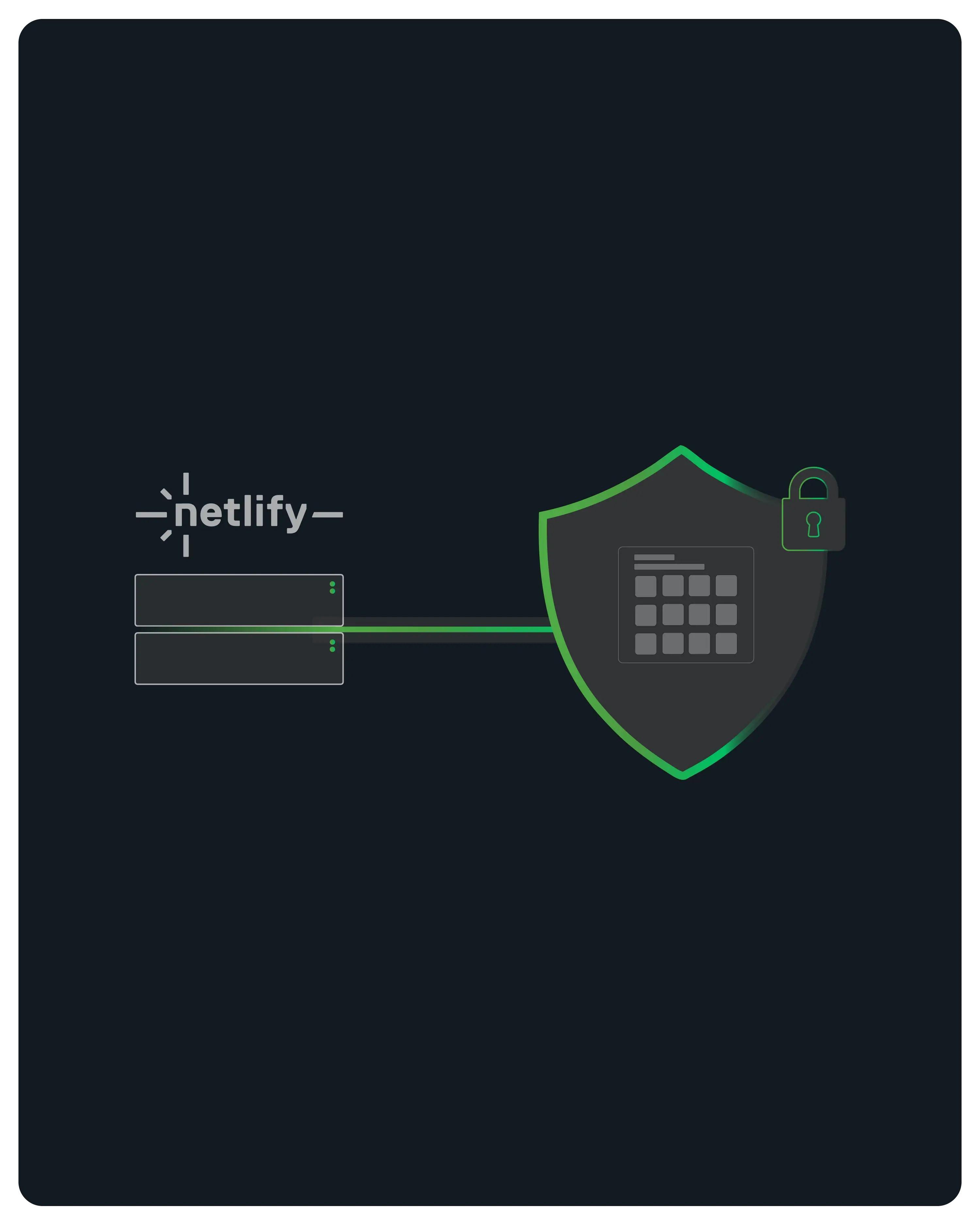
Administrative & Technical Safeguards
Netlify’s global platform is built on an ephemeral CDN architecture where outbound requests from functions originate from over 80+ shifting IPv4 addresses.
Note: QuotaGuard is designed for connecting Netlify infrastructure to IP-restricted B2B resources like SQL databases, internal APIs, and secure gateways. This solution is not intended for web scraping consumer sites (e.g., social media or ticketing platforms) that block cloud infrastructure.

Native Outbound Configuration
QuotaGuard integrates directly with Netlify’s Git-based workflow and environment variable scopes, requiring zero changes to your site's deployment pipeline.
Scoped Environment Variable Support
Utilize Netlify’s "Scopes" feature to securely inject your QuotaGuard credentials only into your Function runtime.
This ensures your connection strings are available for server-side requests while remaining completely inaccessible to the client-side browser, maintaining a strict security perimeter for your sensitive networking data.
Build-Time & Runtime Compatibility
Unlike other proxies, QuotaGuard works during both the Netlify Build phase and the Function Execution phase.
This allows you to securely pull data from restricted private repositories or internal APIs during your site's pre-rendering build process, as well as during live serverless function calls.
Zero-Config Region Matching
Netlify allows you to customize your serverless function region (e.g., us-east-2 or eu-central-1) via the Netlify UI.
You can match your QuotaGuard gateway cluster to your specific Netlify function region to minimize network latency and satisfy strict regional data protection laws like GDPR or CCPA.

Reliability for Serverless Workloads
Netlify’s architecture is optimized for speed and global distribution, requiring a networking layer that doesn't create bottlenecks.

FAQs
Technical answers for routing Netlify applications through a dedicated static IP.
Netlify uses a globally distributed, ephemeral CDN architecture where outbound traffic originates from vast, rotating pools of dynamic AWS and Google Cloud IP addresses.
Because these nodes are added and removed automatically to optimize traffic, Netlify cannot provide a fixed CIDR block for whitelisting.
QuotaGuard solves this by adding a dedicated proxy layer that stays constant even as Netlify’s underlying infrastructure scales or migrates across different cloud nodes.
Yes, QuotaGuard is fully compatible with the Deno-based runtime environment used by Netlify Edge Functions.
Unlike standard serverless functions, Edge Functions act as middleware at the network edge, allowing you to intercept and route requests before they reach the browser.
By utilizing QuotaGuard's HTTP or SOCKS5 protocols within your Edge logic, you can securely access restricted enterprise APIs with the low-latency benefits of edge computing.
To whitelist Netlify, you must route your outbound connection through QuotaGuard and add only your two assigned QuotaGuard Static IPs to your database’s firewall rules.
Since Netlify’s build and function servers use transient IPs that change constantly, attempting to whitelist the hosting provider directly is unreliable and insecure.
QuotaGuard provides a "secure bridge," allowing your serverless code to connect to firewalled SQL or NoSQL databases without exposing your ports to the entire public internet.
The added latency is typically negligible (often under 10ms) if you match your QuotaGuard cluster to the AWS region hosting your Netlify Functions.
Netlify allows you to customize your function region in the site dashboard; by co-locating QuotaGuard in that same region, you ensure the shortest possible "network hop".
This is critical for staying within Netlify’s 10-second (synchronous) or 15-minute (background) function execution limits.
Yes, storing connection strings in Netlify’s Git-integrated environment variables is the industry-standard security practice.
Netlify encrypts these variables at rest and allows you to "scope" them specifically to the build or function runtime, ensuring they are never exposed to the client-side browser.
For added security, QuotaGuard Shield also supports secure proxy authentication tunnels, preventing credential leakage even during the initial connection handshake.
For healthcare teams, QuotaGuard Shield is designed to support encrypted transmission for approved Shield configurations.
BAA review is available after intake review and signed documentation.
By using SSL passthrough, customer payload contents are not decrypted at the proxy in ordinary operation.
Customers remain responsible for determining whether their full Netlify architecture satisfies HIPAA, PCI, or other regulatory obligations.
Yes, QuotaGuard Shield can act as a static inbound entry point (Reverse Proxy) for services that require a single IP to send webhooks or API calls.
While Netlify’s load balancer IPs are dynamic, you can point your third-party service to your QuotaGuard Static IP, which will then securely forward the traffic to your Netlify endpoint.
This eliminates the need for partners to whitelist a rotating pool of CDN nodes and ensures your incoming integrations never break due to provider IP changes.
Still have questions?
We don’t outsource Support to non-Engineers.
Reach out directly to the Engineers who built Shield to discuss your specific architecture, integration challenges, or compliance constraints here 👇
🚀 Ready to Get Started? Choose Your QuotaGuard Path
QuotaGuard STATIC
QuotaGuard SHIELD
Trusted by Engineering Teams Everywhere
Reliability Engineered for the Modern Cloud
For over a decade, QuotaGuard has provided reliable, high-performance static IP and proxy solutions for cloud environments like Heroku, Kubernetes, and AWS.
Get the fixed identity and security your application needs today.