Static Inbound & Outbound IPs for Zapier
The connectivity layer for custom Zaps.
Bridge your Python and JavaScript logic to firewalled databases, internal APIs, and secure banking partners.
Enterprise Connectivity & Identity
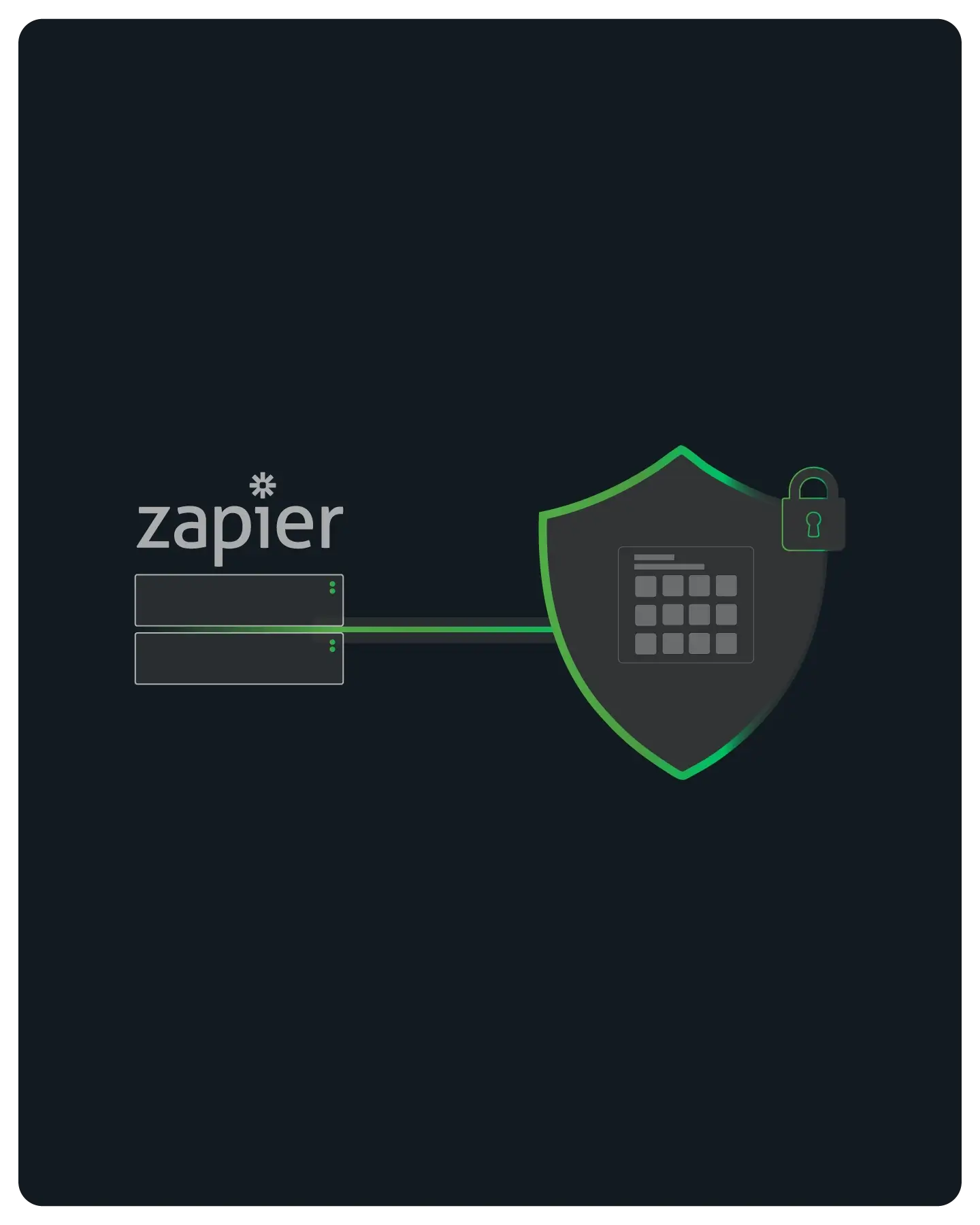
Zapier runs on a massive public cloud with constantly rotating IPs.
This makes it impossible to connect Zaps to security-conscious partners who require strict IP allowlisting. QuotaGuard provides a verifiable, static "Passport" for your custom code steps, giving you a fixed entry point for secure data transfer.
Note: This solution requires "Code by Zapier" steps. It is designed for infrastructure connectivity, not for web scraping consumer sites.

Python & JavaScript Code Steps
While standard Zaps don't support proxies, Zapier’s "Code by Zapier" steps do.
With a few lines of Python or JavaScript (Node.js), you can route requests through QuotaGuard to fetch or push data securely.
Python Requests
Use the standard Python requests library with our simple proxy dictionary to tunnel traffic instantly.
This native integration means you can secure your HTTP calls without installing any external third-party packages.
Node.js (Advanced)
JavaScript code steps can route through QuotaGuard using Node's native http and https modules with the HTTP CONNECT method.
This approach requires more code than Python.
For simpler implementation, we recommend using Python code steps instead.
Copy-Paste Code Snippets
We provide ready-to-use code blocks so you don't have to be a developer to set this up.
Simply copy our templates for GET, POST, or PUT requests, insert your URL, and your secure tunnel is live.

Built for High-Volume Zaps
Whether you run 10 Zaps a day or 10,000, our infrastructure scales with you.
We handle the concurrency and connection pooling so your automation scales effortlessly.

FAQs
Common questions about proxying Code Steps and overcoming Zapier's dynamic network.
Standard app triggers (like Gmail or Slack) are managed internally by Zapier and cannot be proxied.
However, QuotaGuard solves the Inbound requirement for Webhook triggers. If a secure partner needs to send data to your Zap but requires a static destination IP to open their firewall, they can send requests to your QuotaGuard Static IP.
We then securely tunnel that traffic Inbound to your unique Zapier Webhook URL.
For Outbound actions to restricted databases or APIs, you use "Code" steps to route through us.
There is a physical "hop" added to the chain, but it is statistically negligible for automation workflows.
Our infrastructure is hosted in major AWS and Azure data centers, often the same availability zones as Zapier’s own servers, keeping latency typically between 10-30ms. This is well within Zapier’s strict timeout limits.
Our proxies run on 10 AWS regions including the US-East-1 (N. Virginia), US-West-1 (Oregon), CA-Central-1 (Montreal), EU-West-1 (Ireland), EU-Central-1 (Frankfurt), AP-Northeast-1 (Tokyo), AP-Southeast-1 (Singapore), AP-Southeast-2 (Sydney), AP-South-1 (Mumbai) and SA-East-1 (São Paulo) Amazon regions.
The bottleneck in these workflows is almost always the "Code" step cold-start time, not the proxy connection speed.
No.
The native Webhooks app does not currently support proxy configuration.
To route traffic through QuotaGuard, you must use a "Code by Zapier" step (Python or JavaScript).
This allows you to define the proxy parameters explicitly in your HTTP request. We provide copy-paste code snippets for both languages so you don't need to write the logic from scratch.
No.
Zapier’s Python environment comes pre-loaded with the standard requests library.
You simply define your proxy dictionary (proxies = {"http": "...", "https": "..."}) and pass it into your request.
It works out of the box with zero dependency management.
We recommend avoiding hard-coding your connection string inside the code itself. Instead, use the Input Data fields in the Zapier Code step setup.
Map your QuotaGuard URL to a variable (e.g., proxy_url) in the Input Data section.
This keeps your credentials visible only to the Zap editor and clean within the code logic.
Yes, but it requires a "Code" step using a supported driver (like pg for Node.js) configured to tunnel through our SOCKS5 proxy.
Because Zapier code steps are ephemeral (serverless), you must ensure your script opens the connection, executes the query, and closes the connection cleanly within Zapier's strict execution timeout limits to avoid "hanging" connections.
You can, but your security team will likely reject the request.
Zapier utilizes hundreds of dynamic AWS IP addresses that are shared across all their customers. Whitelisting these ranges opens your firewall to traffic from any Zapier user, not just you.
QuotaGuard provides you with two dedicated static IPs (for redundancy) that are exclusively yours, allowing you to lock down your firewall to a single, trusted source.
Still have questions?
We don’t outsource Support to non-Engineers.
Reach out directly to the Engineers who built Shield to discuss your specific architecture, integration challenges, or compliance constraints here 👇
🚀 Ready to Get Started? Choose Your QuotaGuard Path
QuotaGuard STATIC
QuotaGuard SHIELD
Trusted by Engineering Teams Everywhere
Reliability Engineered for the Modern Cloud
For over a decade, QuotaGuard has provided reliable, high-performance static IP and proxy solutions for cloud environments like Heroku, Kubernetes, and AWS.
Get the fixed identity and security your application needs today.