
Static IPs for DocuWare Integrations
Turn on IP-based access control in DocuWare Cloud and only allowlisted addresses can reach your organization, including your API and integration traffic.
A cloud integration with a rotating egress IP gets blocked the moment the allowlist is active.
QuotaGuard gives that integration two fixed IPs you add to the DocuWare allowlist once, so it keeps reaching your organization no matter how its platform changes underneath.

Enterprise Connectivity & Allowlisting
DocuWare Cloud includes a customer-controllable IP allowlist in its Security settings. An administrator enters specific IP addresses or ranges, and once any address is listed, only those addresses can access the DocuWare Cloud organization.
That control covers all access, not just browser logins, so a server-side integration calling the DocuWare Platform API must come from an allowlisted IP.
A document-sync job, a workflow automation, a middleware service, or a custom app running on a cloud platform egresses from a rotating address, which the allowlist rejects. QuotaGuard gives that integration two static IPs that belong to your account, so you allowlist two addresses and never touch the list again.
Note: QuotaGuard is designed for connecting cloud integrations to IP-restricted B2B resources like the DocuWare Platform API, partner APIs, SQL databases, and enterprise gateways. This solution is not intended for scraping consumer sites that block cloud infrastructure.
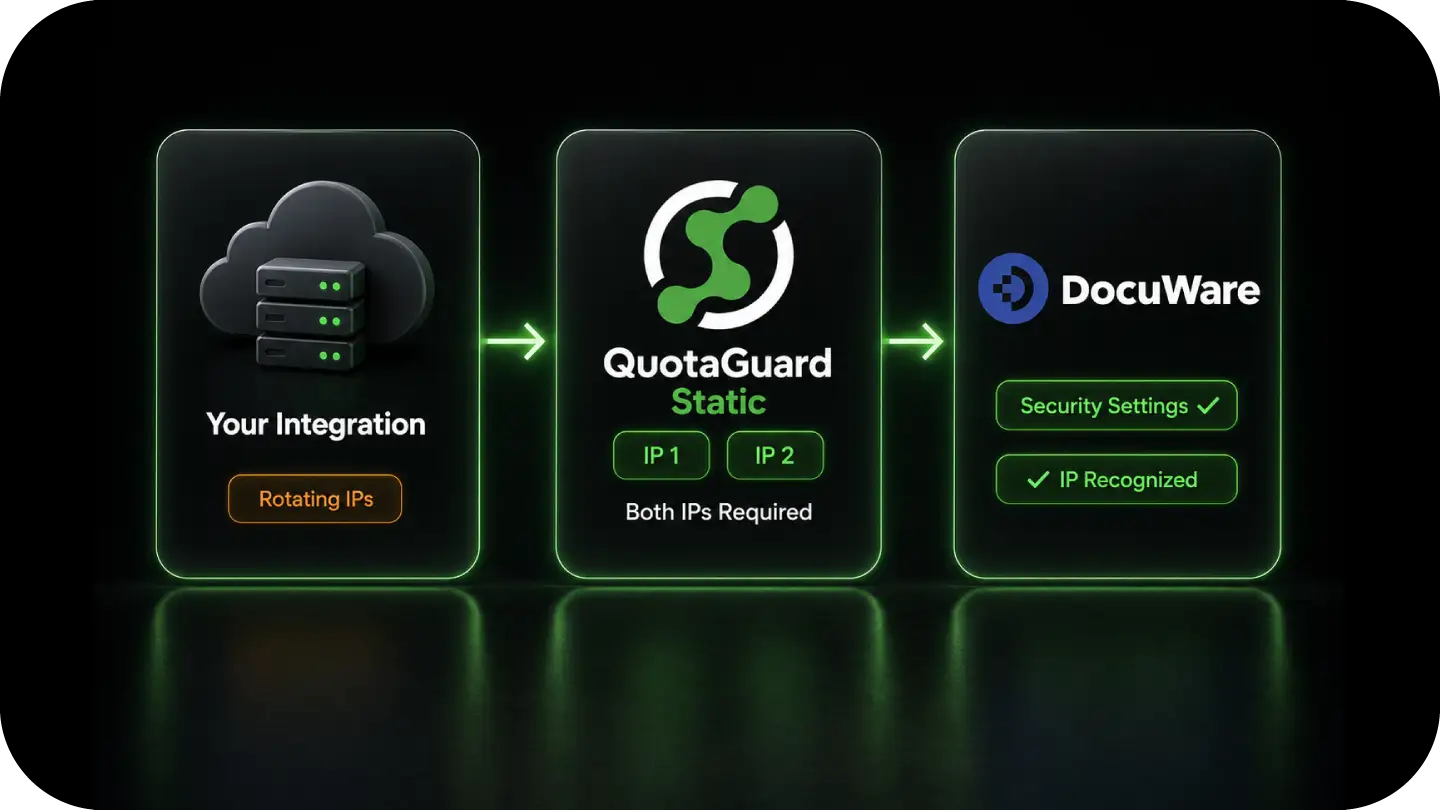
Native Configuration
QuotaGuard works at the application layer through environment variables.
No change to DocuWare, no custom infrastructure. Point your integration's DocuWare Platform API calls through the proxy and they exit from your two static IPs.
Environment Variable Setup
Store your QuotaGuard connection string as an environment variable on your integration's host.
Set the standard proxy variables so HTTP clients route through it automatically, or attach the proxy to the specific calls that reach DocuWare so nothing else is affected.
Most clients in Node.js, Python, Ruby, Go, along with curl, respect the proxy variables without code changes.
Works With the DocuWare Platform API and OAuth
DocuWare Cloud exposes its REST API at your organization's Platform endpoint, authenticated with OAuth 2.0 bearer tokens.
The proxy carries both the token request to DocuWare's identity service and the Platform API calls, so every request that touches DocuWare exits from your two static IPs. Nothing about the authentication flow changes.
Works on Any Integration Host
The setup is the same whether your integration runs on Heroku, AWS Lambda, a container platform, a serverless function, or your own server.
The proxy variables are read by your HTTP client, so there is nothing host-specific to configure and nothing that breaks when your platform changes its egress addresses.

Reliability for Production Integrations
Document workflows run on a schedule and in bursts.
QuotaGuard's proxy layer handles that without becoming the bottleneck, and gives your integration a fixed network identity DocuWare can trust on every request.

FAQs
Technical Configuration and Setup for DocuWare Integrations
Yes.
DocuWare Cloud includes IP-based access control in its Security settings, where an administrator enters specific IP addresses or ranges.
Once any address is listed, only those addresses can access the DocuWare Cloud organization, and the control applies to API and integration traffic as well as browser access. It currently supports IPv4.
Route your integration's DocuWare Platform API calls through QuotaGuard by setting the proxy connection string as an environment variable on your integration's host.
Then add your two QuotaGuard IPs to DocuWare's IP-based access control in Security settings.
Every request to DocuWare then arrives from one of those two fixed addresses.
From the integration host, after configuring the proxy, make a request to https://ip.quotaguard.com.
The response returns the IP your request came from.
It should match one of the two static IPs in your QuotaGuard dashboard. Check a few times and you will see both IPs in rotation.
Yes.
DocuWare Cloud's Platform API uses OAuth 2.0 bearer tokens, and the proxy carries both the token request to the identity service and the Platform API calls.
Every request that reaches DocuWare exits from your two static IPs, and the authentication flow is unchanged.
This page is about DocuWare Cloud, where the IP allowlist is a managed feature and your integration's egress IP is the variable you need to fix.
On-premises DocuWare runs on your own network, where you control egress directly, so a proxy is usually unnecessary for that case.
Yes.
The static IPs are assigned to your QuotaGuard account, not to your hosting platform.
Your integration reads the proxy URL from its environment and connects through the same two IPs regardless of how the platform rotates its egress addresses.
The DocuWare allowlist entry stays valid.
Yes. Select an EU region and your two static IPs are EU-based, in Frankfurt, Ireland, or London, with traffic routed within EU infrastructure.
Enterprise adds dedicated EU IPs, and the Data Residency add-on locks traffic, static IPs, and connection logs to the EU from $899 per month, which supports GDPR data-residency requirements.
Use QuotaGuard Shield for that. DocuWare often stores regulated documents such as HR records, contracts, invoices, and health information.
Shield uses SSL passthrough, and neither Static nor Shield ever decrypts your outbound payload.
Shield's difference is the hop between your app and the proxy: Static's hop uses the plain HTTP proxy protocol, while Shield encrypts it with TLS.
Use Shield for regulated data such as HIPAA or PCI workloads. That supports customers' HIPAA, PCI-DSS, and SOC 2 requirements.
Still have questions?
We don’t outsource Support to non-Engineers.
Reach out directly to the Engineers who built Shield to discuss your specific architecture, integration challenges, or compliance constraints here 👇
🚀 Ready to Get Started? Choose Your QuotaGuard Path
QuotaGuard STATIC
QuotaGuard SHIELD
Trusted by Engineering Teams Everywhere
Reliability Engineered for the Modern Cloud
For over a decade, QuotaGuard has provided reliable, high-performance static IP and proxy solutions for cloud environments like Heroku, Kubernetes, and AWS.
Get the fixed identity and security your application needs today.