QuotaGuard vs Fixie: Complete Static IP Platform vs Outbound Proxy

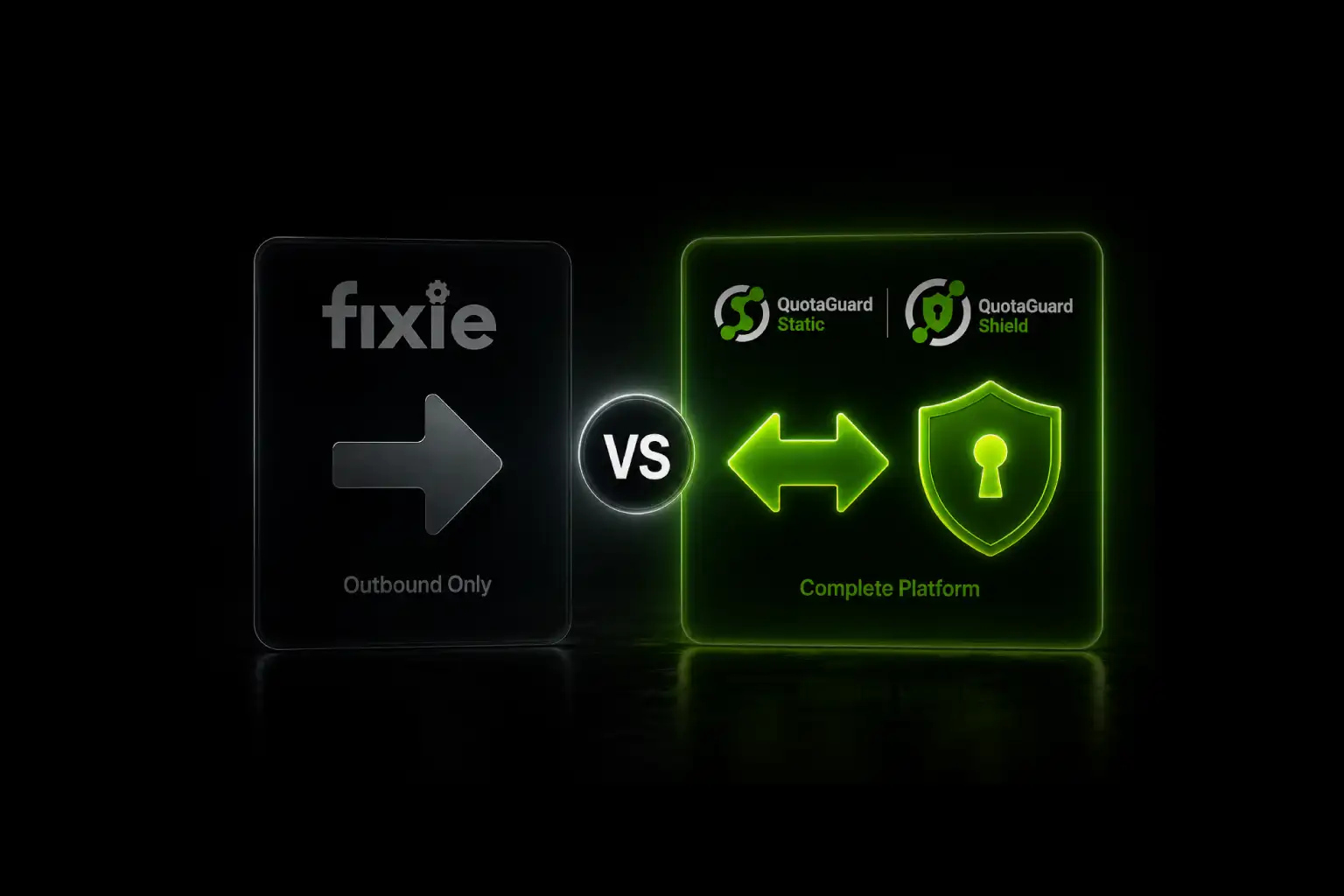
QuotaGuard is a complete static IP platform covering inbound, outbound, SOCKS5, LDAP, and 20+ integrations. Fixie is the outbound HTTP/HTTPS slice with a separate SOCKS add-on.
QuotaGuard and Fixie are often compared as alternatives. They overlap in one area: outbound HTTP and HTTPS proxy traffic for cloud apps that need a static IP for firewall allowlisting. Outside that overlap, the products serve different scopes.
QuotaGuard is a complete static IP platform. Inbound static IPs for corporate clients reaching apps through a fixed address. Outbound HTTP, HTTPS, and SOCKS5 traffic bundled into one product. QGTunnel for transparent TCP wrapping. LDAP, SFTP, FTP, SSH, and database connections through documented patterns. Shield for compliance-sensitive workflows. Dedicated IPs on Enterprise. An SLA. Listings on AWS Marketplace, Azure Marketplace, and Heroku. Integration documentation for 20+ cloud platforms.
Fixie is the outbound HTTP/HTTPS slice of that surface, plus a separate Fixie Socks product for SOCKS5 traffic. No inbound. No LDAP. No named tunneling product. No compliance positioning. No SLA. No AWS or Azure marketplace presence. Coverage of five cloud platforms.
The Product Surface Comparison
Both products handle some of the same use cases. The differences emerge in what each company offers as a documented, marketed capability.
| Capability | QuotaGuard | Fixie |
|---|---|---|
| Outbound HTTP/HTTPS | Yes, standard product | Yes, standard product |
| Outbound SOCKS5 | Yes, bundled | Yes, separate Fixie Socks add-on |
| Inbound static IPs | Yes, marketed product | No, outbound-only across all products |
| TCP tunnel sidecar | QGTunnel, named product with declarative config | fixie-wrench, CLI utility in docs |
| LDAP support | Yes, documented and marketed | No documentation or marketing |
| SFTP, FTP, SSH, databases | Yes, documented | Yes, documented |
| SSL passthrough product | Shield, named product line | No (standard HTTP CONNECT only) |
| HIPAA BAA process | Yes, after intake review and signed documentation | No, never mentioned on site |
| PCI and SOC 2 positioning | Yes, Shield product | No |
| Dedicated IPs | Yes, on Enterprise tier | No, shared IPs at all tiers |
| SLA | Yes, service level commitments with credits | No, ToS disclaims continuous access |
| AWS Marketplace listing | Yes, counts toward AWS committed spend | No |
| Azure Marketplace listing | Yes | No |
| Platform integration coverage | 20+ documented platforms | 5 documented platforms |
The pattern: QuotaGuard offers every capability Fixie offers, plus several Fixie doesn't. The cases where the two products are at parity are outbound HTTP/HTTPS, SOCKS5, and the standard set of TCP protocols documented by both vendors.
Both Proxies Use HTTP CONNECT Tunneling for HTTPS
For HTTPS traffic, Fixie and QuotaGuard Static use the same underlying mechanism: the HTTP CONNECT method. The app sends a CONNECT request to the proxy. The proxy opens a raw TCP tunnel to the origin. TLS bytes pass through without decryption.
Fixie's documentation states it plainly: "Neither Fixie nor any other party has the ability to decrypt this traffic." QuotaGuard Static uses the same architecture. At the transport level for standard HTTPS, the two services are technically equivalent.
This matters because buyers sometimes assume a compliance-focused product has a fundamentally different SSL architecture. It doesn't. The compliance difference between the two services is not about SSL mechanics. It's about what surrounds the technology: documentation, certifications, BAA availability, and explicit positioning for regulated industries.
Inbound Static IPs Are a QuotaGuard-Only Product
Inbound static IPs solve a different problem from outbound. When a corporate client behind a strict firewall needs to connect to an app running on a dynamic cloud platform, the corporate firewall needs a fixed inbound IP to allow. The app's dynamic IPs make this impossible without an intermediary.
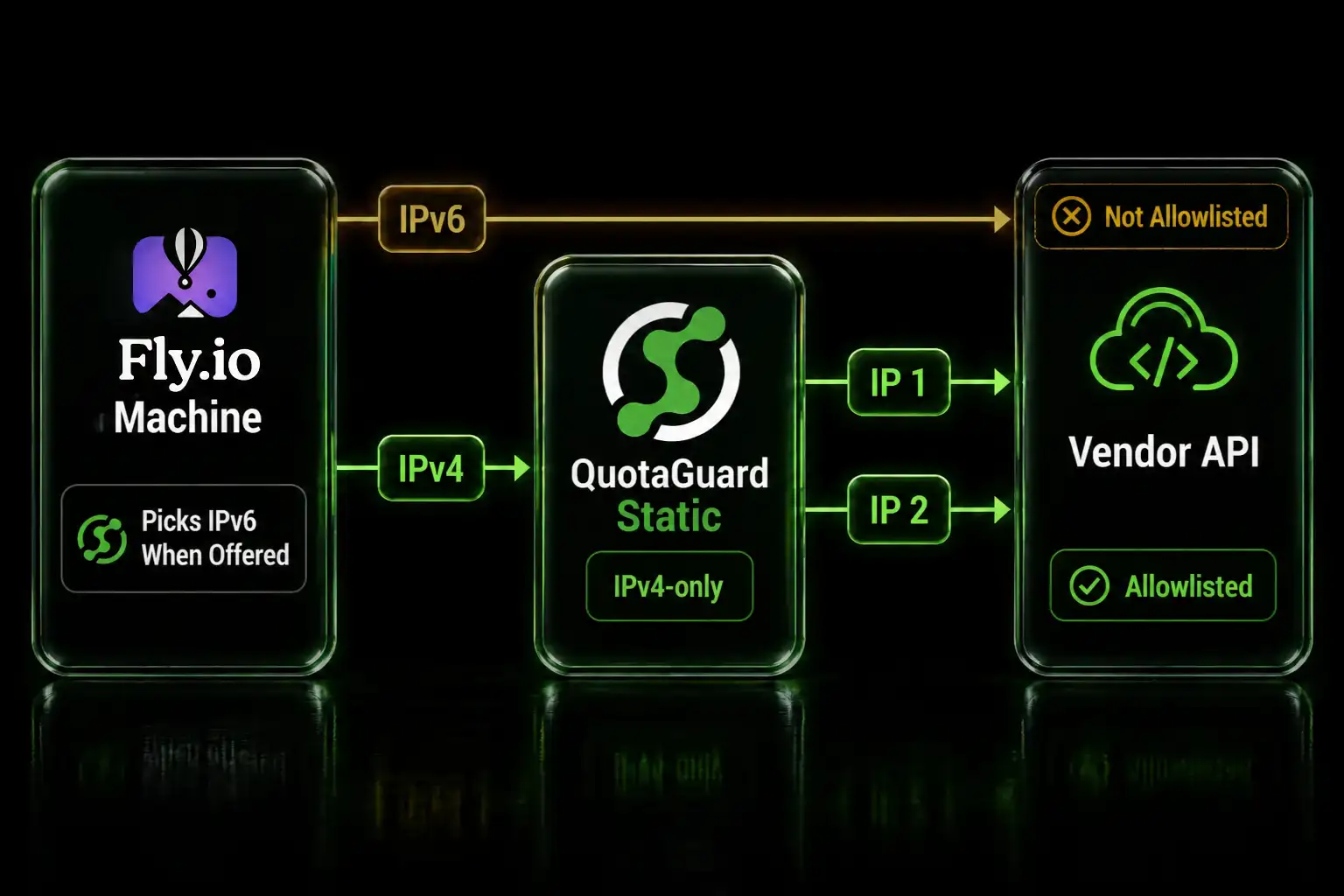
QuotaGuard's inbound product gives the customer a fixed inbound IP that routes traffic to their app on Heroku, Render, Fly.io, or any other cloud platform. Corporate clients allowlist that single IP. The app stays on its dynamic cloud platform without exposing dynamic IPs to the corporate network.
Fixie has no inbound product. The Fixie website, product pages, Heroku Dev Center article, and Vercel marketplace listing all describe outbound-only proxy services. There is no Fixie product for inbound traffic at any price.
QuotaGuard tip: Inbound and outbound static IPs are often needed together. A SaaS vendor connecting to enterprise customers typically needs both: outbound for calling the customer's APIs through an allowlisted IP, inbound for the customer's traffic to reach the vendor through a fixed IP. QuotaGuard handles both with one account. Fixie handles only the outbound half.
QuotaGuard Shield Is the Compliance Product Fixie Doesn't Offer
QuotaGuard Shield is purpose-built for regulated workloads. Shield uses SSL passthrough so QuotaGuard doesn't decrypt customer payload contents in ordinary operation. HIPAA BAA review is available after intake review, QuotaGuard approval, signed documentation, and the annual HIPAA BAA administration add-on. Shield is positioned explicitly for PCI-DSS-sensitive flows, healthcare data in transit, and SOC 2 vendor reviews where proxy-level decryption is not acceptable.
Fixie has no equivalent product. The Fixie site has no HIPAA page, no BAA offering, no PCI-DSS positioning, and no compliance-tier pricing. Their /compliance and /hipaa pages return 404. Fixie's security page cites NIST and CIS Controls as their framework. That's a reasonable infosec posture statement for a general-purpose SaaS tool. It is not a regulated-industry certification claim, and Fixie doesn't market it as one.
If the use case involves health records, payment data, PII in transit, or any audit that requires documentation that no third party decrypts customer traffic, QuotaGuard Shield is the product built for that. Fixie doesn't operate in that space.
LDAP, Active Directory, and Legacy Protocols Are Documented on QuotaGuard
Enterprise integrations frequently require LDAP queries against Active Directory or other corporate directory services. Cloud apps running on Heroku, Render, and similar platforms can't reach corporate LDAP servers without a static IP that the corporate firewall trusts.
QuotaGuard explicitly documents LDAP support. Multiple integration guides cover Ruby and other runtimes connecting to firewalled LDAP servers through QuotaGuard's static IPs.
Fixie has no LDAP documentation anywhere on its site. The word "LDAP" doesn't appear in their docs or product pages. LDAP traffic could technically work over Fixie Socks since it's TCP, but the vendor has no documentation or example code for that use case.
QuotaGuard Bundles SOCKS5. Fixie Sells It Separately.
QuotaGuard's standard product includes both HTTP/HTTPS proxy and SOCKS5 endpoints on every plan. Customers get both protocols with a single subscription. The customer chooses which to use based on the traffic type.
Fixie's standard product is HTTP/HTTPS only. Customers who need SOCKS5 must add Fixie Socks as a separate purchase, with its own pricing tiers and its own environment variable (FIXIE_SOCKS_HOST). A customer who needs both protocols pays for both products.
For databases, SFTP, and arbitrary TCP traffic, both services work. Fixie Socks documents PostgreSQL, MySQL, MongoDB, SFTP, and SSH explicitly. QuotaGuard supports the same use cases in the bundled product, and also covers LDAP, which Fixie does not document.
For customers using both HTTP outbound and SOCKS5 for database connections, the QuotaGuard model is simpler and often cheaper. QG's Production tier at $49/month covers both protocols. Fixie's equivalent coverage requires Hybrid at $49 plus a SOCKS plan at $29 or more, depending on volume.
Both Services Include a TCP Tunnel Utility for Non-HTTP Workloads
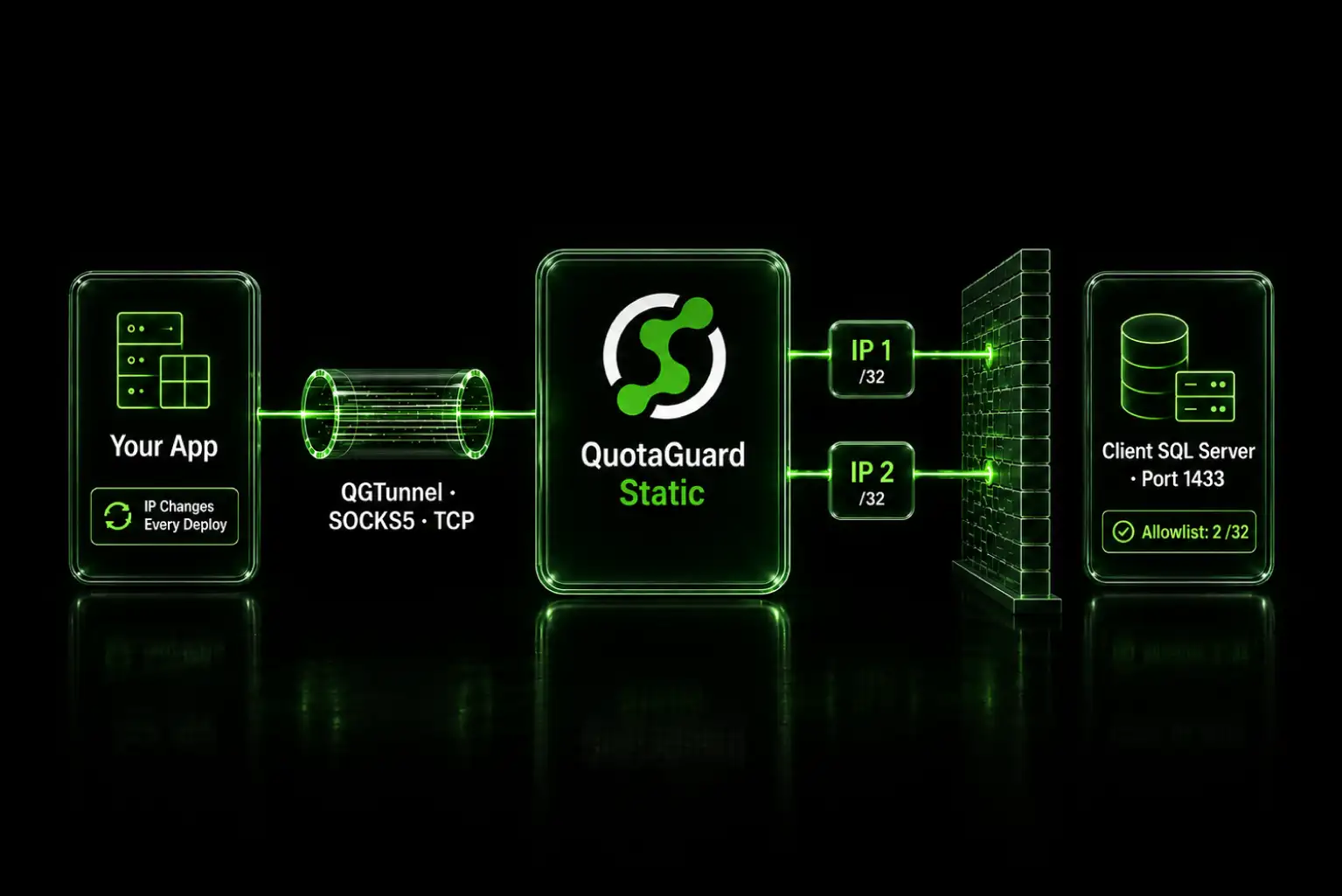
Both products offer a way to wrap TCP traffic that doesn't natively support proxies. The mechanical approach is similar: a local sidecar process opens a port that the application connects to, and the sidecar forwards traffic through the proxy with the static IP.
QuotaGuard markets QGTunnel as a named product with its own documentation, declarative configuration via a config file, supported platforms list, and integration guides.
Fixie ships fixie-wrench as a CLI utility. The customer installs it and runs it via their Procfile alongside their app.
web: ./bin/fixie-wrench 5432:db.example.com:5432 & bundle exec pumaFor database connections or SFTP through a static IP on Heroku, Fly.io, or Render, both approaches work. The positioning difference matters for customers evaluating vendor commitment: a named product with versioned documentation signals different investment than a CLI utility buried in setup docs.
QuotaGuard Offers Dedicated IPs on Enterprise. Fixie Doesn't at Any Price.
QuotaGuard's Enterprise tier and above include dedicated static IPs reserved for the customer's account. Shared IP tiers below Enterprise have two static IPs that are stable for the customer but shared with a small group of other QuotaGuard customers using the same proxy infrastructure.
Fixie has shared static IPs at every tier. There is no dedicated IP option at any price point.
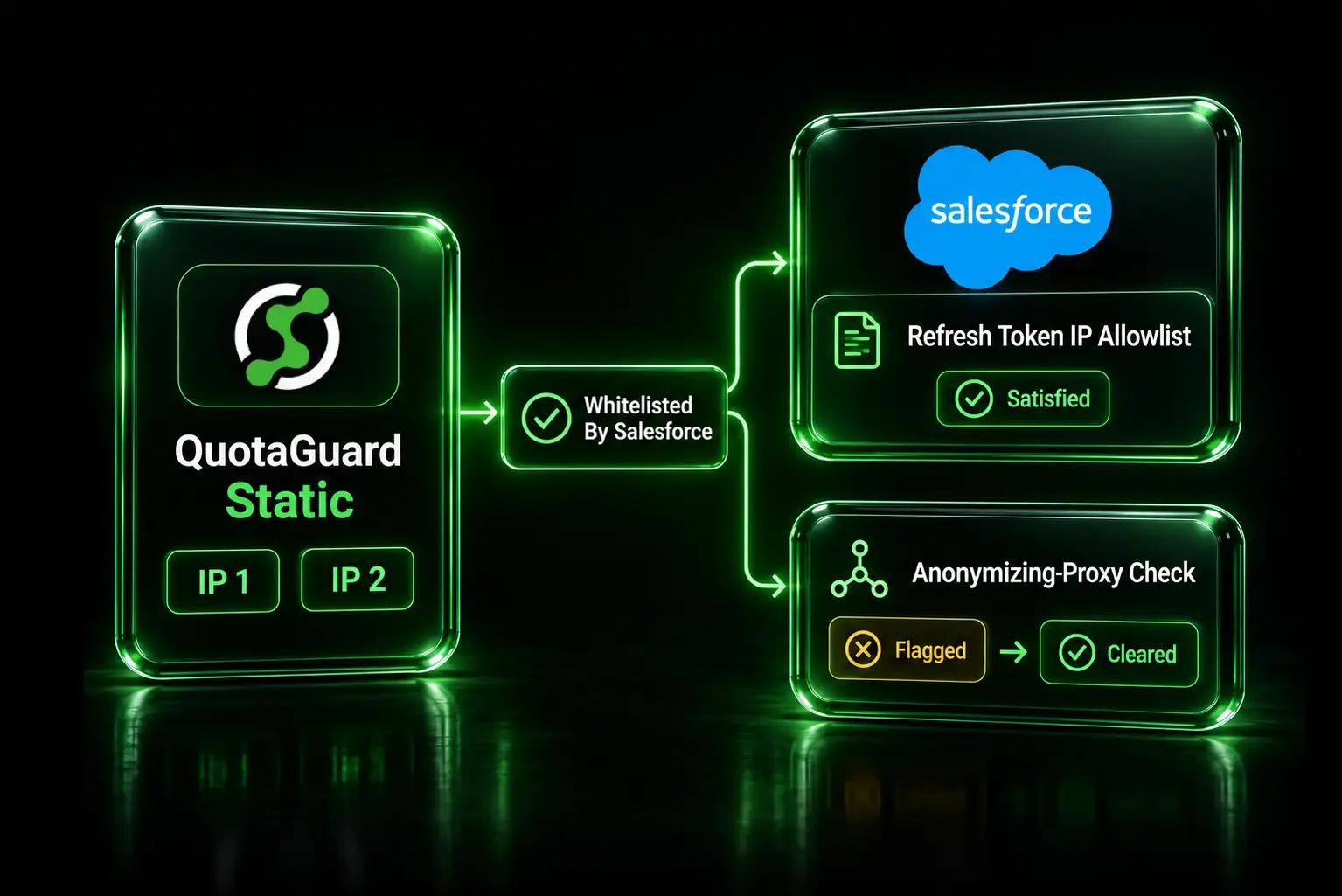
Dedicated IPs matter in two cases. First, reputation-sensitive destinations. Some APIs (Salesforce, Google APIs, certain banking platforms) score traffic based on the upstream IP's reputation. A shared IP can carry traffic patterns from unrelated customers that affect how the destination scores the customer's own traffic. Second, compliance posture. Some auditors prefer or require that production traffic to regulated destinations leave from infrastructure dedicated to the customer's account.
If either applies, QuotaGuard's dedicated IPs on Enterprise tier ($219/month Static or $259/month Shield direct) are the answer. Fixie cannot address this use case at any price.
QuotaGuard Has an SLA. Fixie Explicitly Disclaims One.
QuotaGuard's terms include service level commitments for paying customers, with downtime credits when commitments aren't met.
Fixie's Terms of Service include the verbatim language: "We do not guarantee continuous, uninterrupted access." There is no SLA. There are no downtime credits.
For production customers running revenue-critical traffic through the proxy (payment APIs, banking integrations, customer-facing OAuth flows), the SLA distinction is structural. A vendor that explicitly disclaims reliability is a different category of vendor than one that commits to it contractually.
QuotaGuard Is on AWS Marketplace and Azure Marketplace. Fixie Is Not.
QuotaGuard is listed on AWS Marketplace and Azure Marketplace alongside Heroku and direct signup. For customers with AWS Enterprise Discount Program (EDP) commitments or Private Pricing Agreements, QuotaGuard purchases through AWS Marketplace count toward the customer's committed spend. The Azure listing serves similar enterprise procurement workflows.
Fixie is on Heroku and direct only. There is no AWS Marketplace listing and no Azure Marketplace listing. For enterprise customers with AWS or Azure committed spend, Fixie purchases must come out of separate budget rather than counting against the cloud commitment.
This also constrains the platforms Fixie naturally serves. Customers building on AWS Lambda, Azure Functions, or any AWS or Azure native service have to procure Fixie outside their normal cloud spend flow. QuotaGuard customers procure through the cloud they're already deploying into.
Platform Coverage: QuotaGuard 20+, Fixie 5
Fixie has dedicated documentation and landing pages for five platforms: Heroku, Vercel, Fly.io, Render, and Koyeb. The Vercel integration is particularly strong: Fixie has a native Vercel Marketplace integration that auto-provisions environment variables when added from the Vercel dashboard. That's a smoother setup than QuotaGuard offers on that one platform.
QuotaGuard has integration pages and multi-post blog coverage for more than 20 platforms, including Heroku, Vercel, Fly.io, Render, Railway, Koyeb, AWS Lambda, Azure Functions, Google Cloud Functions, Google Cloud Run, Bubble.io, Lovable, Replit, Supabase Edge Functions, n8n, Make, Zapier, Salesforce, MongoDB Atlas, Docker, Kubernetes, GKE, Gigalixir, Pantheon, Netlify, and others.
AWS Lambda and Railway have no Fixie documentation at all. Neither do the major automation platforms (n8n, Zapier, Make, Airtable). None of the AI builder platforms (Lovable, Bubble, Replit) have any Fixie coverage. Customers on those platforms either build their own setup against Fixie's general documentation or migrate to a vendor that documents the platform.
Mixed Workloads: QuotaGuard Handles Both Compliance and Standard Traffic
For teams with mixed workloads where some traffic is compliance-sensitive and some is not, QuotaGuard Static and QuotaGuard Shield can run side by side on the same account. Standard traffic routes through Static. Compliance-sensitive flows route through Shield. Both are available on Heroku, AWS Marketplace, Azure Marketplace, and direct signup.
Fixie cannot serve the compliance side of this split. Customers with mixed workloads on Fixie have to add a second vendor for any traffic that requires HIPAA BAA, PCI positioning, or SOC 2 vendor-review documentation. QuotaGuard handles both from one account, one billing relationship, one support contract.
Fixie's Free Tier Is for Evaluation, Not Production
Fixie's HTTP proxy starts free at 500 requests and 100 MB per month. Their SOCKS proxy also has a free tier at 100 requests and 100 MB. These are useful for development, integration testing, and learning. For current tier details, see usefixie.com/pricing.
QuotaGuard has no free tier on direct signup. Entry pricing is $19/month for Static or $29/month for Shield. The 3-day trial includes full production capacity (10 GB bandwidth on Starter) so customers can test the integration under realistic load.
For developers who want to test before committing, Fixie's free tier is a genuine advantage. For production workloads where bandwidth, SLA, and compliance matter, the free tier ceases to be relevant.
Where Fixie Is the Better Fit
Fixie is the right choice when:
- The use case is outbound HTTP/HTTPS only, on Heroku, Vercel, Fly.io, Render, or Koyeb.
- The Vercel Marketplace integration's auto-provisioned environment variables specifically matter for that one platform.
- The integration is a hobby project where Fixie's free Tricycle plan is sufficient.
- No inbound traffic is needed.
- No LDAP, no regulated data, no SLA requirement, no dedicated IP need.
- The customer doesn't need AWS or Azure Marketplace procurement.
Where QuotaGuard Is the Better Fit
QuotaGuard is the right choice when:
- Inbound static IPs are part of the architecture (corporate clients reaching the app through a fixed address).
- LDAP, Active Directory, or other corporate directory services are part of the integration.
- The integration touches regulated data (PHI, payment cards, financial PII) where Shield's compliance positioning and HIPAA BAA process matter.
- Mixed workloads need both Static and Shield from one account.
- The destination is reputation-sensitive (Salesforce, Google APIs, banks) where dedicated IPs on Enterprise tier protect against shared-IP reputation issues.
- An SLA is required by audit posture, customer contracts, or risk management.
- The platform is outside Fixie's covered five, particularly AWS Lambda, Azure Functions, Lovable, Replit, Salesforce, n8n, Make, Zapier, Supabase, or Docker/Kubernetes.
- AWS Marketplace or Azure Marketplace procurement matters for committed spend or enterprise terms.
- The customer wants HTTP/HTTPS and SOCKS5 in a single bundled product.
QuotaGuard Static Pricing Starts at $19/Month
Bandwidth is bundled. Both HTTP/HTTPS and SOCKS5 included. Most production integrations fit comfortably in the Starter or Production tiers. Dedicated IPs are available on Enterprise and above. On lower tiers, your two assigned IPs are still static, but shared with a small group of other customers.
QuotaGuard Shield Pricing Starts at $29/Month
Shield costs slightly more than Static at each tier because SSL passthrough adds routing overhead. Shield is the right choice when the integration handles regulated data or customers require SSL passthrough as part of their vendor security review. The compliance coverage Shield provides (HIPAA-eligible architecture, PCI-sensitive flows, SOC 2 vendor-review support) is worth the difference for the audiences that need it.
All plans include a 3-day trial. Enterprise plans include a 7-day trial. Credit card required.
See the full pricing table at quotaguard.com/products/pricing.
Choose Based on Product Scope, Not Just Price
The cleanest way to choose between the two products is to start with the use case, not the price. If the integration is outbound HTTP/HTTPS only, on one of Fixie's covered platforms, with no compliance requirements and no inbound traffic, both products work and pricing is comparable.
If the integration involves any of the capabilities Fixie doesn't offer (inbound, LDAP, compliance posture, dedicated IPs, SLA, AWS or Azure Marketplace procurement, broader platform coverage), QuotaGuard is the structural answer because Fixie doesn't compete on those capabilities.
Setup takes 2 minutes either way. The 3-day QuotaGuard trial includes full production bandwidth so customers can test the integration under realistic load. To evaluate which fits a specific architecture, contact us and an engineer will respond directly.
QuotaGuard Static IP Blog
Practical notes on routing cloud and AI traffic through Static IPs.