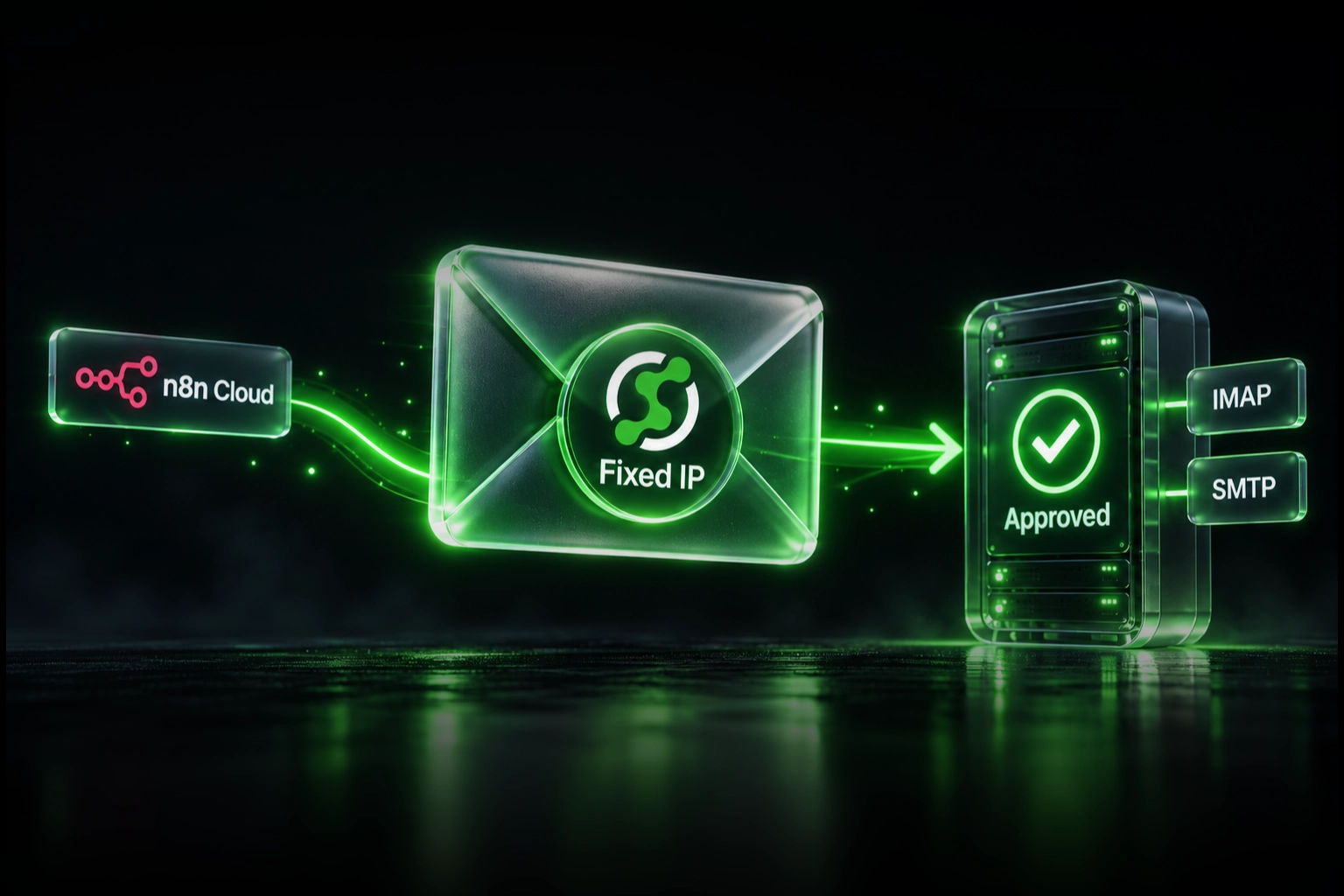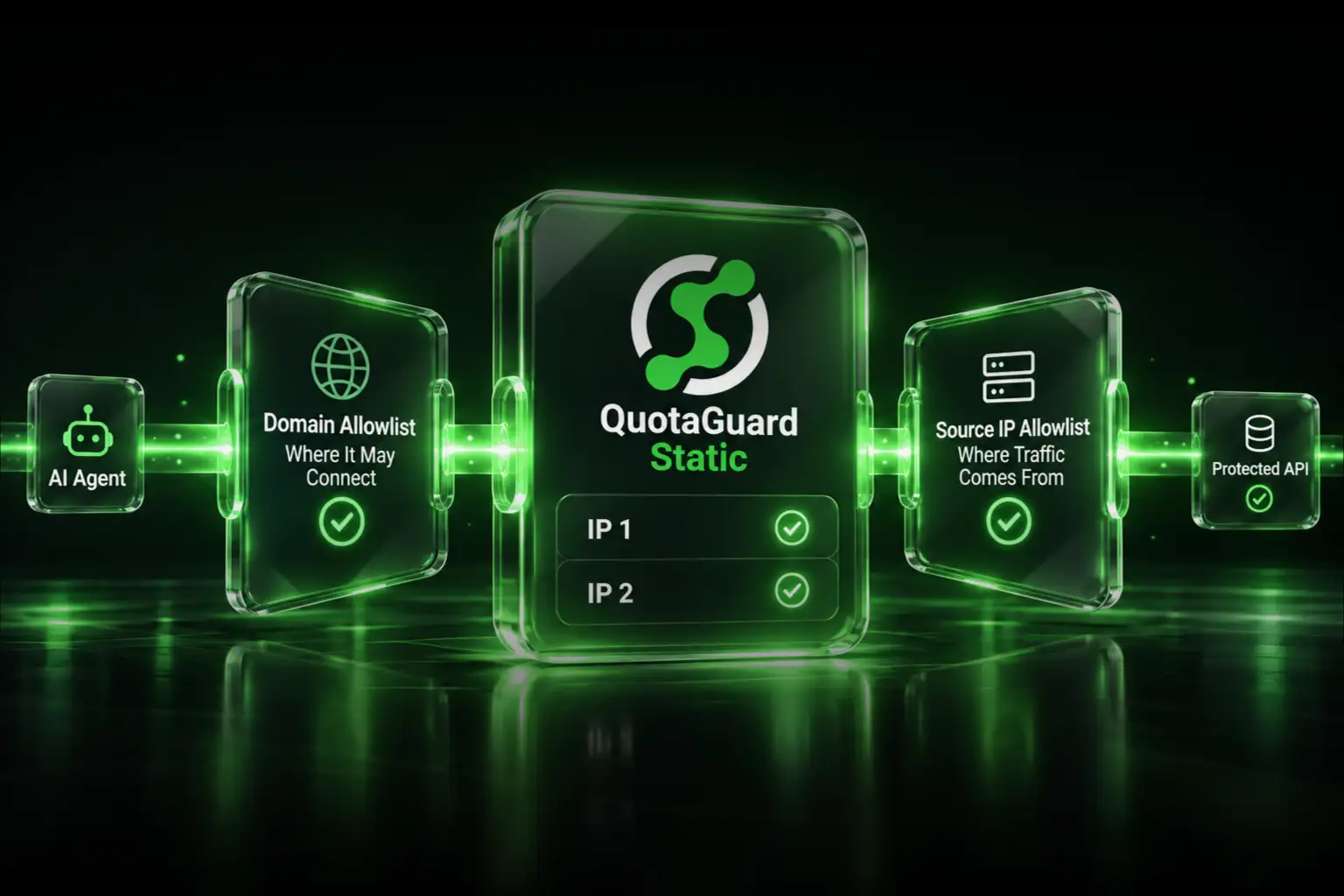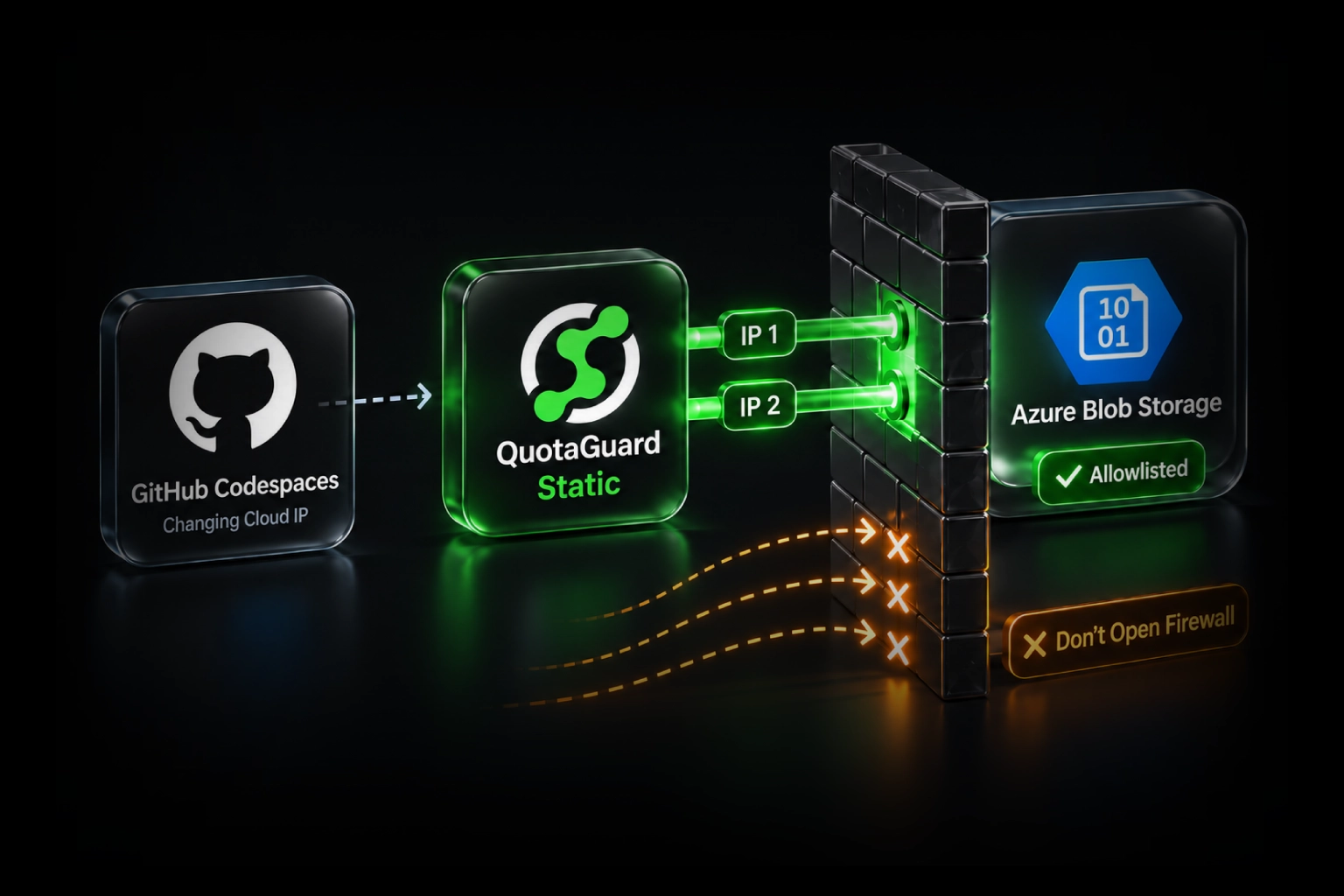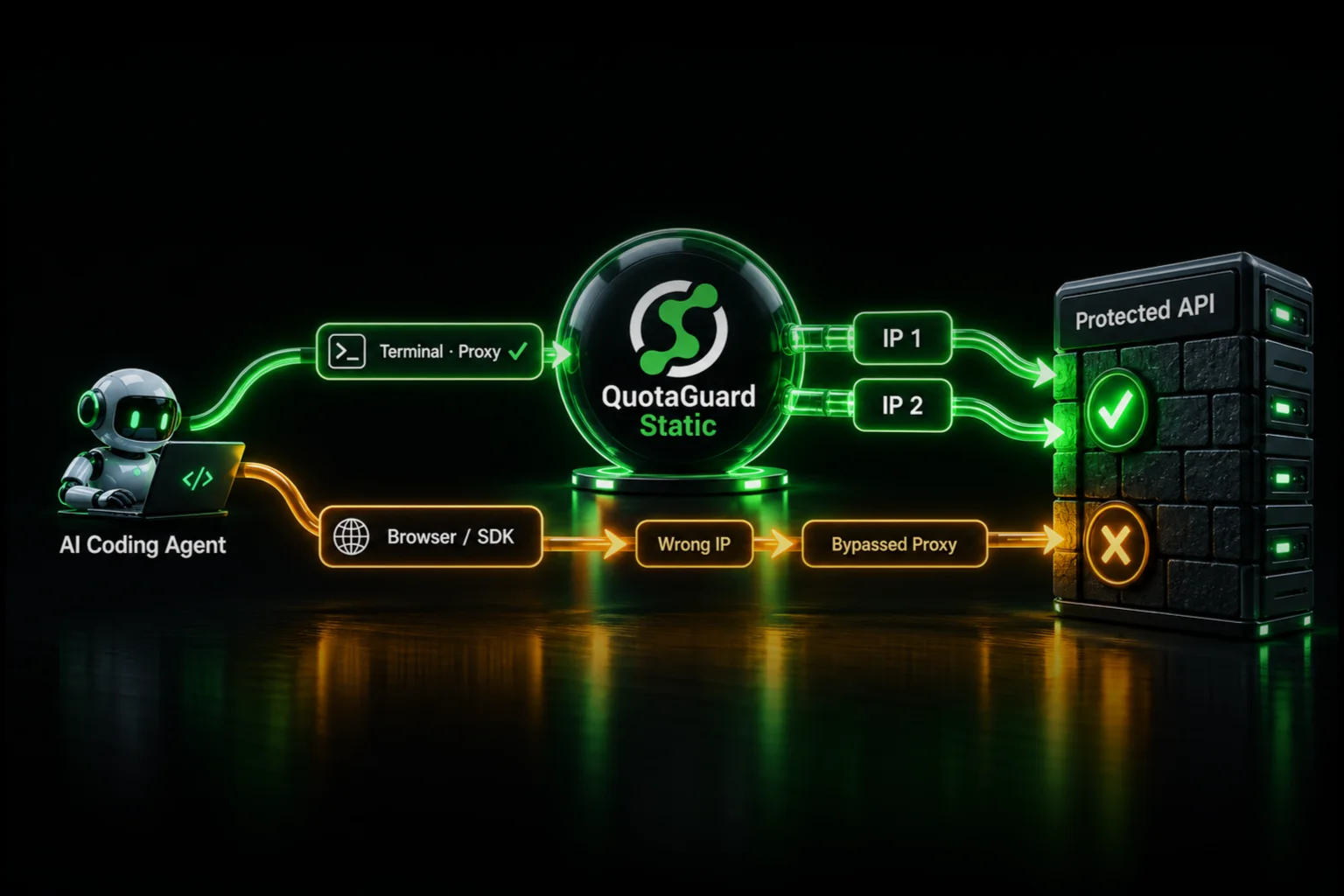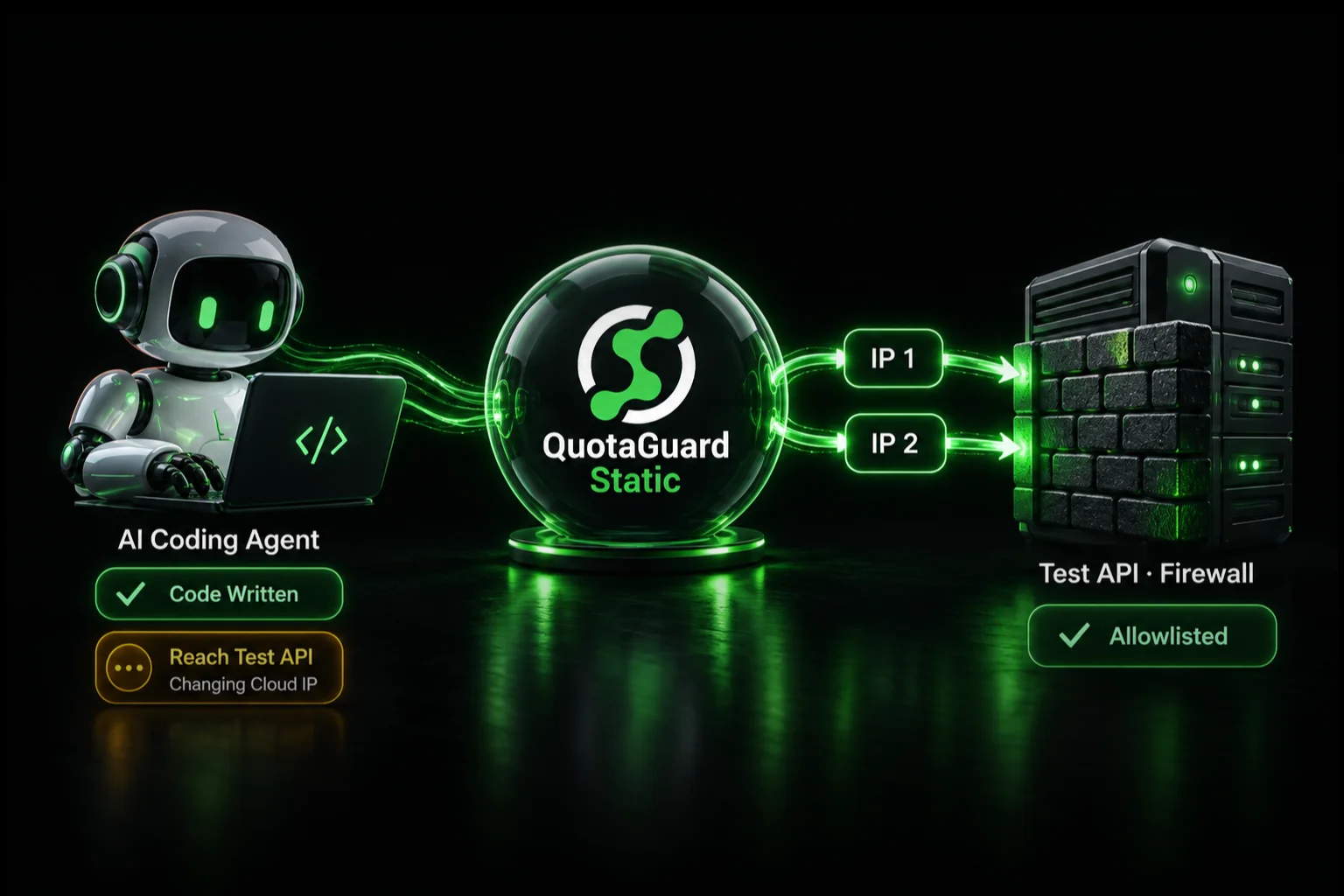


Railway makes it easy to expose an application by hostname. But some enterprise customers won't approve the connection until you provide fixed destination IP addresses for their firewall. QuotaGuard provides those addresses through a managed inbound proxy, so your application can stay on Railway.
The customer connects through the stable QuotaGuard hostname and allows the subscription's two static IPs through its firewall. QuotaGuard forwards each approved request to the Railway HTTPS endpoint you already operate.
QuotaGuard Gives Railway Apps a Stable Inbound Front Door
QuotaGuard's inbound proxy separates the address your customer approves from the infrastructure running your application. Railway can deploy, restart, scale, or move the service without forcing the customer's network team to approve a new destination every time the origin changes.
The customer connects to a hostname backed by the QuotaGuard static IP pair. QuotaGuard receives the request and forwards it to the configured Railway origin. Your Railway application continues handling authentication, authorization, validation, and business logic.
QuotaGuard treats the pair as a subscription-level network identity. It isn't tied to one Railway deployment. If the application later moves to another Railway region or another hosting platform, the customer-facing addresses can stay the same while you update the forwarding destination.
Railway's Native Static IPs Cover Outbound Traffic Only
Railway offers Static Outbound IPs for connections leaving a Railway service. Those addresses help when a database, API, or partner firewall needs to recognize the Railway application as the caller.
Railway's documentation states that those addresses can't receive inbound traffic. They won't give an enterprise customer a fixed destination for reaching your application.
Railway Static Outbound IPs
- Apply to connections leaving the Railway service.
- Help external APIs and databases identify the Railway application.
- Can't receive inbound customer traffic.
- Change if the service moves to another Railway region.
QuotaGuard Inbound Static IPs
- Give customers a fixed destination for reaching the Railway application.
- Forward requests to the Railway HTTPS origin.
- Remain independent of the Railway deployment.
- Use a managed pair for availability and failover.
A Railway-generated domain or custom domain makes the service reachable by hostname. It doesn't provide the small, stable destination IP set required by a strict enterprise firewall. If the customer's policy accepts a hostname, Railway's normal domain configuration may be enough. If the customer requires exact destination IPs, QuotaGuard fills the gap.
Two QuotaGuard IPs Give Enterprise Teams a Small Allowlist
Enterprise networking teams usually want a short implementation sheet. Give them the customer-facing hostname, both QuotaGuard IP addresses, the port, the protocol, the expected request path, and the application authentication method.
The customer must connect to the configured hostname. It shouldn't browse directly to a raw QuotaGuard IP address. QuotaGuard uses the hostname to identify the correct inbound route and forward the request to your Railway application.
Both IP addresses matter. Every QuotaGuard subscription includes two load-balanced static IPs. The customer should allowlist both so maintenance or failover doesn't send valid traffic through an unapproved address.
A Managed Inbound Proxy Keeps the Network Pager Off Your Team
You can build a static front door with proxy virtual machines, public addresses, a load balancer, health checks, and custom routing. That design also creates a production network service your team must own.
A self-managed deployment usually needs at least two proxy nodes for redundancy. Someone must patch them, monitor them, test failover, manage certificates, plan capacity, investigate latency, and respond when the route fails outside business hours.
QuotaGuard operates that layer as a managed service. Your team keeps the Railway application and its business logic. QuotaGuard manages the proxy infrastructure, static address pair, availability, maintenance, and support.
The difference isn't merely the monthly cost of an IP address. It's the engineering time and production responsibility attached to the complete route.
Five Steps Put the Railway App Behind Stable Inbound IPs
- Confirm the customer's rule. Ask whether the firewall controls destination IP, hostname, port, protocol, or all four. Confirm that it can approve two addresses for availability.
- Prepare the Railway origin. Generate a Railway public domain or configure a custom domain. Confirm that the deployed application responds correctly over HTTPS.
- Create the QuotaGuard inbound proxy. Enter the Railway HTTPS URL as the forwarding destination in the QuotaGuard dashboard.
- Provide the connection details. Give the customer the QuotaGuard-facing hostname, both assigned IPs, the port, and the application authentication requirements.
- Test the real customer path. Verify the hostname, TLS behavior, request path, authentication, application logs, and both allowlisted addresses from a restricted network.
The dashboard configuration takes about 2 minutes. New inbound configuration changes can take up to 10 minutes to propagate. Test the actual customer route before treating the connection as production-ready.
QuotaGuard's Static inbound proxy guide documents the current dashboard, custom-domain, DNS, and certificate steps.
QuotaGuard Static Pricing Starts at $19/Month
QuotaGuard Static includes inbound and outbound proxy capability. Bandwidth is bundled. There aren't per-GB overage fees. The Starter plan includes 10 GB of monthly bandwidth. Dedicated IPs are available only on Enterprise. On lower tiers, your subscription's two assigned IPs remain static but are shared with other customers.
Static is the normal choice for a Railway application that needs a stable HTTPS front door. For inbound HTTPS, Static terminates TLS at the QuotaGuard proxy and forwards the request to the configured Railway origin.
QuotaGuard Shield Pricing Starts at $29/Month
QuotaGuard Shield costs slightly more because SSL passthrough adds routing overhead. Shield is built for compliance-sensitive architectures where proxy-level TLS termination isn't acceptable. The TLS connection remains end-to-end, and QuotaGuard doesn't decrypt customer payload contents in ordinary operation.
Use Shield when the Railway application handles healthcare records, payment information, PII, or another workload whose approved security design requires SSL passthrough. Customers remain responsible for determining whether the complete architecture satisfies HIPAA, PCI-DSS, SOC 2, or another compliance obligation.
All standard plans include a 3-day trial. Enterprise plans include a 7-day trial. A credit card is required. See the complete QuotaGuard Static and Shield pricing table.
Regional Placement Controls Latency and Capacity Planning Controls Spend
An inbound proxy adds a network hop. Traffic travels from the customer to QuotaGuard and then from QuotaGuard to Railway. That extra hop adds latency, so regional placement matters.
QuotaGuard runs in 12 AWS regions. Choose the region at signup based on the customer location, the Railway origin, and any applicable residency requirement. Changing the region later requires help from QuotaGuard support. Editing a hostname won't move an existing subscription to another region.
Measure representative production requests before launch. Include normal traffic, peak traffic, response sizes, health checks, retries, and expected growth. A modest request count can still use significant bandwidth when the application returns large files or data exports.
QuotaGuard plans use soft limits so a brief spike doesn't automatically break production traffic. Sustained usage above the selected plan still requires right-sizing the subscription.
TLS and Application Controls Remain in Place After the Proxy
A static destination solves the customer's network requirement. It doesn't authenticate the caller or authorize an application action.
Keep the controls already protecting the Railway application:
- HTTPS across the approved external path.
- API keys, OAuth, mTLS, signed requests, or another suitable authentication method.
- Least-privilege authorization and tenant isolation.
- Rate limits, request validation, application logs, and anomaly alerts.
- Origin controls when bypassing the QuotaGuard route would violate the security model.
A difficult-to-guess Railway URL isn't an access control. QuotaGuard forwards traffic to a reachable Railway origin. Your application still decides who may use the service and what each caller may do.
Enterprise Dedicated Infrastructure Handles Customer-Only Requirements
QuotaGuard Starter, Production, and Business subscriptions use stable IP pairs on shared managed infrastructure. The addresses stay fixed for the subscription, but they aren't reserved exclusively for one customer.
QuotaGuard Enterprise includes dedicated IPs and dedicated proxy resources. Use Enterprise when the contract, security review, or compliance architecture requires customer-only infrastructure. Static Enterprise starts at $219 per month. Shield Enterprise starts at $269 per month.
Dedicated infrastructure provides network isolation and reserved resources. It doesn't replace application authentication, authorization, monitoring, or capacity planning.
QuotaGuard Removes the Firewall Blocker From the Railway Sale
Railway's native Static Outbound IPs solve connections leaving a service. QuotaGuard solves the opposite requirement. It gives enterprise customers a fixed destination for reaching the Railway application.
The customer gets a small allowlist. Your application stays on Railway. The address pair remains portable. QuotaGuard owns the inbound proxy infrastructure and the operational work behind it.
Give your Railway application a stable enterprise-facing IP pair.
Start a QuotaGuard trial or talk to QuotaGuard engineering about the Railway origin, expected traffic, regional placement, and shared or dedicated infrastructure requirements.
Railway Inbound Static IP Questions Answered
Does Railway provide a static inbound IP?
No. Railway provides Static Outbound IPs for connections leaving a service. Railway states that those addresses can't receive inbound traffic.
Can I keep my Railway custom domain?
Yes. You can keep the Railway domain as the forwarding origin. Configure the customer-facing hostname through the QuotaGuard inbound setup so it resolves through the stable QuotaGuard IP pair.
Can customers connect directly to a QuotaGuard IP address?
No. Customers connect to the configured hostname and allowlist both associated IP addresses. The hostname lets QuotaGuard route each request to the correct Railway application.
Why must customers allowlist two addresses?
The pair supports load balancing and failover. If the customer approves only one address, valid traffic using the other route may be blocked.
Are standard QuotaGuard IPs dedicated?
No. Starter, Production, and Business subscriptions use shared managed infrastructure. Enterprise subscriptions include dedicated IPs and proxy resources.
Will QuotaGuard add latency?
Yes. The proxy adds another network hop. Choose the region carefully and test representative production traffic before launch.
Will QuotaGuard make the Railway origin private?
No. QuotaGuard forwards traffic to a reachable Railway origin. Keep strong application authentication and add appropriate origin restrictions when the approved architecture requires them.
Can the IP pair survive a Railway migration?
Yes. Update the QuotaGuard forwarding destination after the origin moves. The customer-facing hostname and static IP pair can remain unchanged.