
Why a Static IP Proxy Is the Wrong Tool for High-Volume Email Validation

QuotaGuard Engineering
July 6, 2026
5 min read
Pattern

If you are planning to run high-volume SMTP email validation through a static IP proxy, a small pool of fixed IPs is the wrong tool. Your addresses will get blocklisted within hours, and the real problem is that your results stop being trustworthy without telling you. Use a purpose-built email verification service instead.

We get this question often enough to write it down. A developer is building an email validation service that performs an SMTP handshake against each address to check whether it is deliverable, plans to run millions of checks per day, and wants a pool of static IPs to send that traffic through. The surface question is "do your proxies support this." The honest answer is that the approach itself works against you, no matter whose IPs you use, so here is the full reasoning before you build on it.

High-Volume SMTP Probing Looks Identical to Spam, So It Gets Treated Like Spam

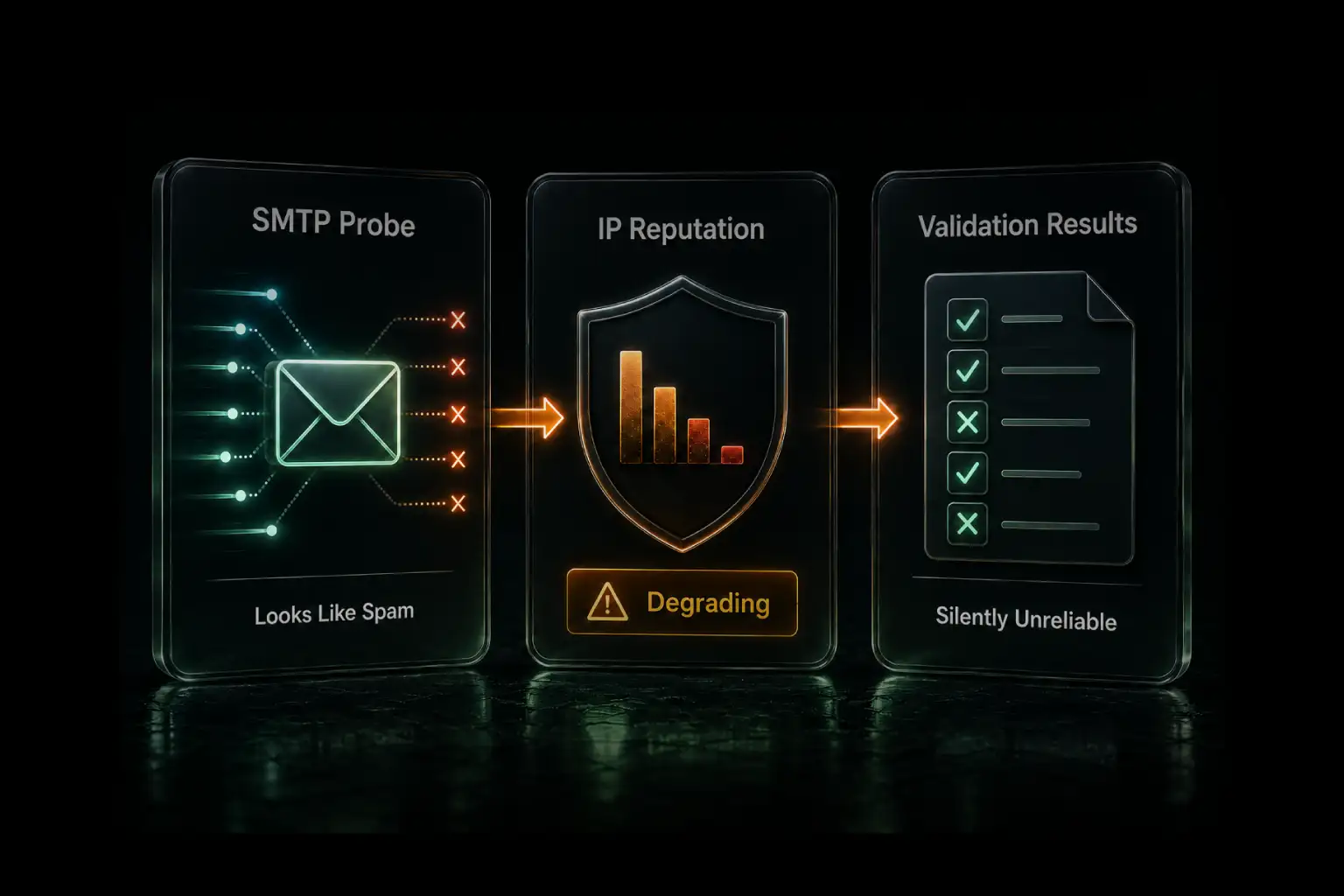
An SMTP handshake that opens a connection to a mail server, starts the delivery conversation, and then disconnects without sending is exactly the pattern spammers use to build and clean target lists. Mail providers and blocklist operators cannot read intent. They see the pattern and act on it. At a few million handshakes a day from a small set of source IPs, those IPs get flagged quickly by systems like Spamhaus and Microsoft's sender reputation services, and once an IP is flagged, receiving servers start rejecting its connections outright. Your legitimate validation traffic is indistinguishable from abuse at the network layer, so it inherits the same consequences.

The Failure Mode Most People Miss: Your Results Quietly Become Wrong

This is the part that makes the approach dangerous rather than just inefficient. When a receiving server rejects your connection because your IP is blocked, your validation logic sees a failed handshake. A failed handshake reads as "this address is undeliverable." But the address might be perfectly valid. What failed was your reputation, not their mailbox.

From inside your own system, a blocked IP and a genuinely dead address look the same. So as your IPs degrade, your validation results fill up with false negatives you have no way to detect. You ship a product that confidently marks good addresses as bad, and the data gets worse the longer you run it. A tool that is silently unreliable is worse than one that obviously fails, because you trust it right up until it costs you real customers.

Consumer Providers Throttle Per Source IP Within Minutes

Gmail, Outlook, and iCloud detect connection probing fast and throttle per source IP, often within minutes. From a small pool of fixed addresses at high volume, your real throughput against the large consumer domains will be a fraction of what you planned for. You cannot brute-force this with a handful of IPs, because the throttling is keyed to the source address, and you only have a few.

General-Purpose Proxy IPs Are Not Set Up as Mail Hosts

Set volume and blocklisting aside for a moment. A static IP proxy is built to give outbound API and database traffic a fixed, allowlistable identity. It is not configured the way a legitimate mail-originating host is, with matching reverse DNS, a proper HELO identity, and the surrounding reputation signals receiving servers check. Even a low-volume handshake from that kind of IP produces noisier, less reliable answers than infrastructure built for email. You would be reading deliverability signals through a tool that was never tuned to produce them.

How Real Email Verification Actually Works

Purpose-built email verification is a different operational model, and understanding it explains why a proxy pool cannot stand in for it.

First, the providers that do this at scale run large pools of warmed datacenter IPs, hundreds to thousands, under active reputation management. They monitor blocklist status, rotate and rest addresses, and keep reverse DNS and sending identity clean. That is a full-time infrastructure discipline, not a side effect of buying proxy IPs.

Second, and more importantly, they treat the SMTP handshake as the last resort, not the first step. Most addresses never need one. The cheap, safe signals come first: syntax and format checks, domain and MX record lookups, detection of catch-all domains that accept everything, disposable-domain detection, and historical bounce data. Those filters resolve the large majority of addresses without ever touching a receiving mail server. Only the genuinely ambiguous remainder gets a real handshake, which keeps probing volume low enough to stay under reputation thresholds. The layered funnel is the whole trick, and it is the opposite of running a handshake against every address through a fixed IP.

What to Use Instead

If your goal is to validate email addresses, use a service built for it rather than assembling one from proxies. Established email verification providers, such as Kickbox, NeverBounce, and ZeroBounce, expose a simple API, absorb the reputation and infrastructure burden, and return a deliverability verdict per address. They have already solved the layered-signal approach and the IP-pool management that make the results trustworthy. The names here are examples of the category, not endorsements; evaluate them against your own volume and accuracy needs.

If you are determined to build your own, the takeaway is the same in a different form: the hard part is not the handshake, it is the reputation management and the signal layering that let you avoid most handshakes. A small pool of static IPs gives you neither. Budget for a large, actively managed pool and a cheap-signals-first pipeline, or use a vendor that already has both.

When a Static IP Proxy Is the Right Tool

To be clear about where a static IP proxy does fit, since that is what we build: it is the right tool when an outbound integration needs a fixed, known identity to be allowlisted by the service it talks to. An API that only accepts requests from approved IPs, a firewalled database, a partner gateway that requires a registered source address. That is a connection-identity problem, and a stable pair of static IPs solves it cleanly. High-volume email validation is a reputation-and-signal problem wearing a connection-identity costume, and the same tool does not solve both. Knowing which problem you actually have saves you a test period that would only end in blocklisted IPs.

If your use case is the first kind, we are happy to help. If it is email validation, we would rather point you to the right tool than sell you the wrong one.

QuotaGuard Static IP Blog

Practical notes on routing cloud and AI traffic through Static IPs.

Reliability Engineered for the Modern Cloud

For over a decade, QuotaGuard has provided reliable, high-performance static IP and proxy solutions for cloud environments like Heroku, Kubernetes, and AWS.

Get the fixed identity and security your application needs today.