

On February 6, 2026, Salesforce announced that Heroku is transitioning to a "sustaining engineering model." The announcement, written by SVP and GM Nitin T. Bhat, says Heroku will focus on "stability, security, reliability, and support" rather than introducing new features. Enterprise Account contracts are no longer available to new customers, though existing contracts and renewals are unaffected.
If you read between the lines, the message is clear. Salesforce is redirecting investment toward AI and away from Heroku. The platform is not shutting down tomorrow. But the forward roadmap is gone.
For the thousands of developers running production workloads on Heroku with QuotaGuard static IPs, this raises an obvious question. What happens to your static IP setup?
The short answer: nothing changes right now. And if you decide to move later, your static IPs come with you.
(Here is our guide to migrate off Heroku to a different platform)
What Actually Changed
Let's be specific about what the announcement does and does not say.
What's staying the same:
Your apps, pipelines, teams, and add-ons keep running. Pricing and billing are unchanged for credit card customers, both existing and new. Existing enterprise contracts will be honored and can renew as usual. Heroku remains a supported, production-ready platform.
What's different:
No new Enterprise Account contracts for new customers. No new features. Engineering investment is being moved to Salesforce AI initiatives. The word "sustaining" is doing a lot of heavy lifting in that announcement.
Simon Willison put it well when he noted that "sustaining engineering model" is not a widely used industry term. It means they'll keep the lights on. The community response has been a mix of nostalgia and resignation. Heroku was revolutionary. It made deploying applications simple in a way that nothing else did in 2007. But the writing has been on the wall for years.
What This Means for QuotaGuard Customers on Heroku
If you're currently running QuotaGuard Static or QuotaGuard Shield on Heroku, here's what you need to know.
Your QuotaGuard add-on is not affected. Your static IPs, your proxy credentials, your SOCKS5 tunnels, your inbound proxy setup. All of it continues working exactly as before. Heroku's add-on ecosystem is part of what's being maintained under the sustaining model.
Your static IPs are not tied to Heroku. This is the critical point. QuotaGuard runs on AWS infrastructure, independent of Heroku. Your static IP addresses are assigned to your QuotaGuard account, not to your Heroku dyno. If your app moves, your IPs don't have to. We proved this at scale in 2022 when Heroku killed free dynos and hundreds of customers migrated their workloads. The process was seamless then, and it is the same now.
You don't need to do anything today. Heroku is not shutting down. Your production workloads are fine. But if you're starting to think about a migration timeline, now is a reasonable time to plan.
The Static IP Problem When Migrating Off Heroku
Heroku has never provided static outbound IP addresses. Dynos get dynamic IPs from AWS, and those IPs can change at any time. This has always been one of the main reasons developers use QuotaGuard on Heroku.
When you migrate to a new platform, most things change. Your deployment process changes. Your CI/CD pipeline changes. Your environment variables change. Your buildpacks become Dockerfiles or platform-specific configs.
But your static IPs don't have to change.
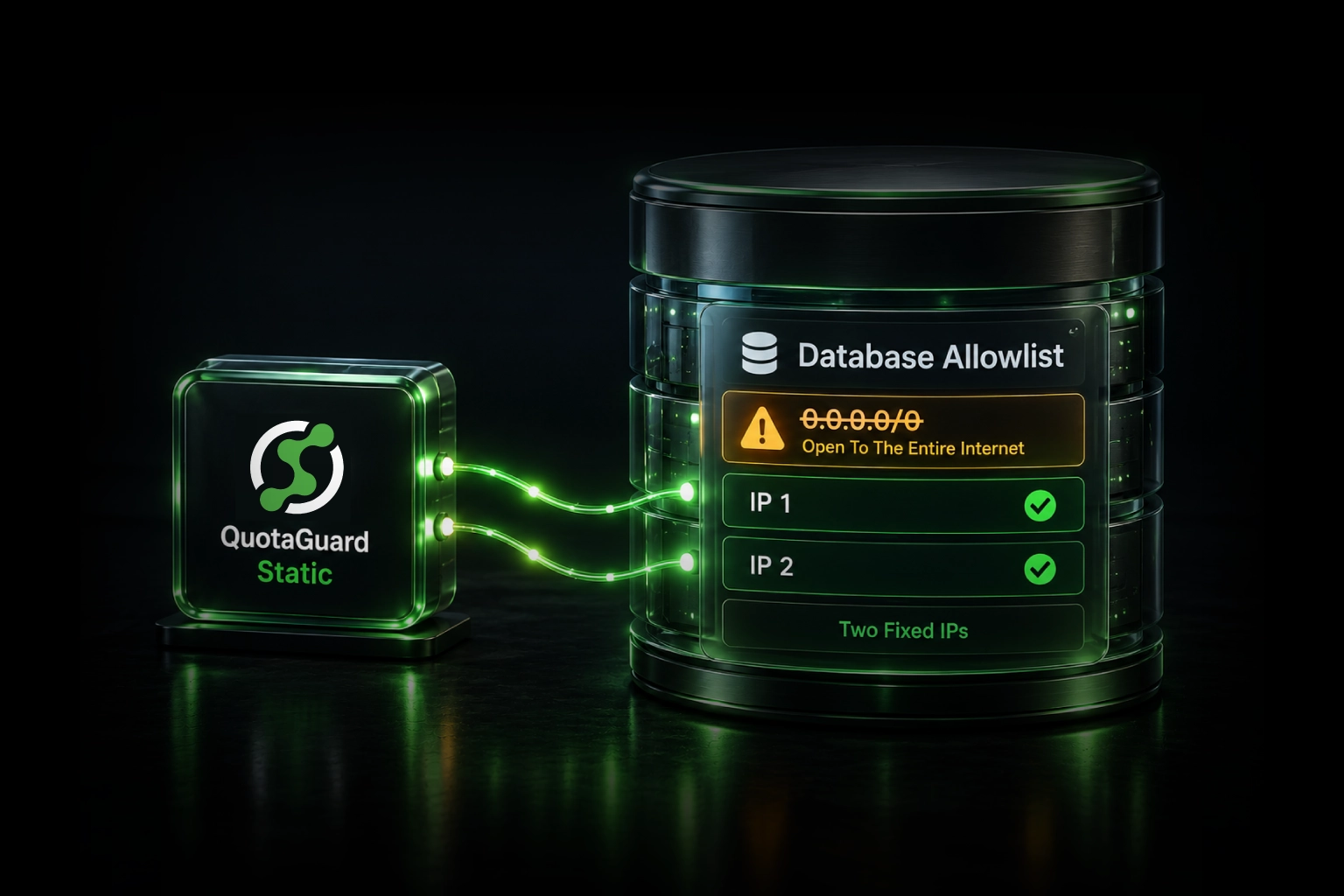
Every firewall allowlist rule you have configured at a partner API, every database allowlist entry, every IP-restricted webhook receiver. If those point to your QuotaGuard static IPs, they stay exactly the same after migration. You update your app proxy configuration on the new platform, and your external integrations never notice the difference.
This is the one piece of your infrastructure that is genuinely platform-independent. QuotaGuard works the same way whether your app runs on Heroku, Fly.io, Render, Railway, Kubernetes, or a bare EC2 instance.
Platform-by-Platform Migration Guides
We've spent the last several months building comprehensive integration guides for every major Heroku alternative. The timing here was not planned around the Heroku announcement. We've been expanding our platform coverage for a while. But the guides are ready when you need them.
Here's where to start depending on where you're headed:
Modern PaaS (closest to the Heroku experience):
- Fly.io Static IP Integration and technical setup guide
- Render Static IP Integration and technical setup guide
- Koyeb Static IP Integration and technical setup guide
- Gigalixir Static IP Integration and technical setup guide
Containers and orchestration:
Serverless and edge:
AI and automation workflows:
Low-code and CMS:
Cloud providers:
Each guide includes platform-specific setup instructions, code examples in multiple languages, and configuration for both HTTP proxy and SOCKS5 database connections.
How to Migrate Your QuotaGuard Setup
We have done this before. In August 2022, Heroku announced the end of free dynos, and we helped hundreds of customers migrate their static IPs off the Heroku marketplace. The process is well tested.
The short version: you sign up for a direct QuotaGuard account, we swap your existing Heroku subscription behind the scenes so you keep the same IPs and credentials, you remove the Heroku add-on, and you reset the environment variable. Zero downtime. No IP changes. No firewall updates needed.
We wrote a detailed step-by-step guide during the 2022 migration wave, and it still applies exactly: How to Migrate Your Static IPs Off Heroku
The key points: you keep the same static IPs, the same credentials, and the same proxy URL. We do a hot swap on our side. Your Heroku apps are not affected during the process, and no downstream firewall rules need to change.
If you are migrating to a completely new platform (not staying on Heroku), the process is even simpler. Sign up directly at quotaguard.com, set the QUOTAGUARDSTATIC_URL environment variable on your new platform, and deploy. Every integration guide linked above includes the platform-specific instructions for setting environment variables and configuring your HTTP client.
Either way, the net result is the same. You keep your static IPs, your firewall rules stay intact, and you move from Heroku marketplace billing to direct billing.
A Note on Timing
There's no rush. Heroku is not shutting down next month, and panic migrations cause more problems than they solve. For most engineering teams, what looks like a "migration" is actually closer to a rewrite. DNS cutover is the easy part. Rearchitecting deployment pipelines, CI/CD, environment management, and add-on replacements takes real planning.
Take the time to evaluate where you want to go. Test your target platform. Run both environments in parallel if you can.
The one thing you can do right now with zero risk is sign up for a direct QuotaGuard account and verify that your static IPs will carry over. That removes one variable from the migration plan entirely.
What About Heroku Add-on Partners?
We've been a Heroku add-on partner since 2013. We've served thousands of Heroku customers through the marketplace. We're not going anywhere, and we will continue supporting Heroku customers for as long as the platform operates.
This is the second time we have guided customers through a major Heroku transition. The first was in 2022 when free dynos were removed. We built migration tooling, wrote documentation, and handled hundreds of account swaps. That infrastructure and experience is still in place.
We've also been investing in platform-independent documentation and direct onboarding because we believe developers should have choices. The fact that we now have integration guides for over a dozen platforms is not a reaction to this announcement. We have been expanding platform coverage for over a year.
QuotaGuard has always been a network-layer service that sits outside your application platform. That's the whole point. Your platform can change. Your static IPs don't have to.
Questions?
If you have questions about migrating your QuotaGuard setup, or if you want help planning a transition off Heroku, reach out to our team.
- Email: support@quotaguard.com
- Phone: 1-833-373-9522
Our average first response is under 26 minutes during business hours. For migration planning, we're happy to get on a call.
View All Integration Guides | View Pricing | Sign Up Direct
QuotaGuard Static IP Blog
Practical notes on routing cloud and AI traffic through Static IPs.