
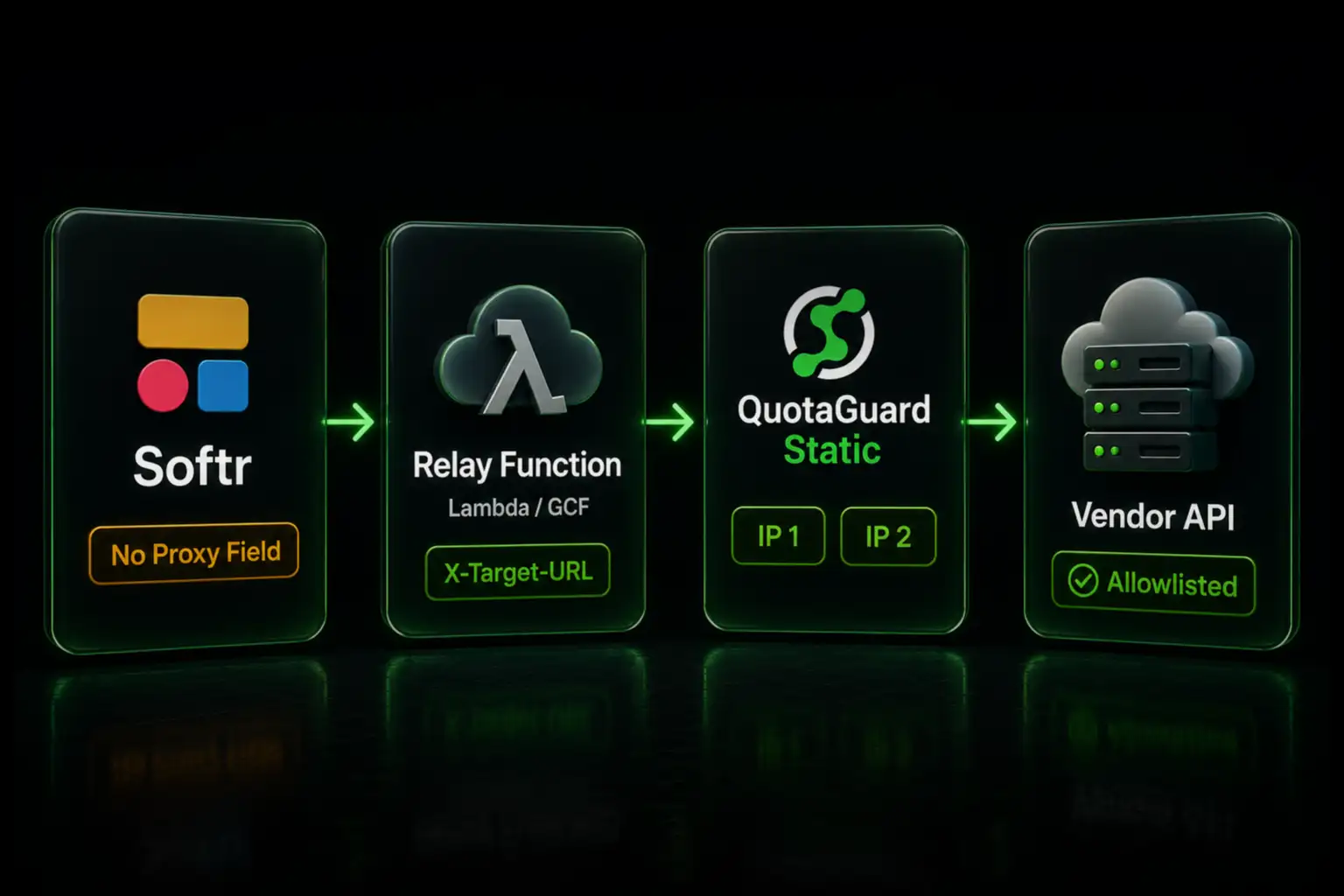
Give Softr a Static Outbound IP With a Relay Function

QuotaGuard Engineering
July 27, 2026
5 min read
Pattern

Softr's Call API action can't set a proxy, so route it through a small relay function that egresses via QuotaGuard's two static IPs.

Plenty of Softr builders hit an IP allowlist wall the moment they connect a serious backend. The Call API action works in testing, then the vendor turns on IP allowlisting and every request starts failing. Softr runs the call server-side and gives you no proxy field, so there's no fixed address to hand the vendor. A relay function you host is the standard way around it.

Softr Runs Your Call API Request Server-Side With No Proxy Option

The Call API action lets you send a POST, PUT, PATCH, or DELETE request to any REST endpoint or webhook. You configure a URL, an HTTP method, header parameters, and a body. That's the full surface. See Softr's Call API documentation for the current field list. There's no place to set an HTTP proxy and no setting for a fixed outbound IP. The request leaves from infrastructure you don't manage, so the source IP isn't stable and isn't something you can allowlist.

A Relay Function Gives Softr Two Fixed Static IPs

Softr can't set a proxy or run a sidecar, so you host a small relay function instead. It's an AWS Lambda or a Google Cloud Function that egresses through QuotaGuard. Softr calls the relay's URL. The relay forwards your request through the QUOTAGUARDSTATIC_URL connection, and the target API sees QuotaGuard's two load-balanced static IPs. Every QuotaGuard subscription includes two static IPs behind a load balancer. Allowlist both with your vendor.

QuotaGuard publishes a ready-to-run relay you can deploy as-is: the lambda-relay example. The reusable pattern is documented at Static IP without an HTTP proxy. The relay reads two headers on each request. X-Relay-Key is a shared secret so only your Softr app can use it. X-Target-URL is the real API you want to reach.

Point the Softr Call API Action at Your Relay

Once the relay is deployed, change your Call API action so the Base URL is the relay's function URL instead of the target API. Keep your existing body. Add the two relay headers. Put the real destination in X-Target-URL and your secret in X-Relay-Key.

Softr Call API action
----------------------
Method:   POST
Base URL: https://your-relay-function-url.example.com

Header parameters:
  X-Relay-Key   your-shared-secret
  X-Target-URL  https://api.vendor.com/v1/records
  Content-Type  application/json

Body (key/value):
  name    John Smith
  email   john@example.com

The relay forwards that body to the URL in X-Target-URL over the QuotaGuard connection. Here's the same request as curl, which is useful for testing the relay before you wire it into Softr:

curl -X POST "https://your-relay-function-url.example.com" \
  -H "X-Relay-Key: your-shared-secret" \
  -H "X-Target-URL: https://api.vendor.com/v1/records" \
  -H "Content-Type: application/json" \
  -d '{"name":"John Smith","email":"john@example.com"}'

Confirm the Static IPs With a Test Call

Before you send real traffic, point X-Target-URL at QuotaGuard's IP echo endpoint. It returns one of your subscription's two static IPs.

curl -X POST "https://your-relay-function-url.example.com" \
  -H "X-Relay-Key: your-shared-secret" \
  -H "X-Target-URL: https://ip.quotaguard.com"

Run it twice and you'll see the response alternate between your two IPs as the load balancer rotates. Both are static. Allowlist both with your vendor so either one passes the firewall. QuotaGuard's static IPs come from QuotaGuard's AWS infrastructure, which is why they stay fixed for the life of your subscription.

Standard HTTPS API Calls Use QuotaGuard Static

QuotaGuard Static is right for standard HTTPS API calls. The payload is tunneled end to end and is never decrypted at the proxy, so your relay can forward normal REST traffic without exposing the contents. This covers the large majority of Softr integrations: CRMs, billing systems, internal APIs, and third-party services that gate access by IP.

Regulated Data Uses QuotaGuard Shield

If your Softr app moves regulated data, use QuotaGuard Shield instead. Shield uses SSL passthrough, so the TLS connection runs end to end and QuotaGuard doesn't decrypt your payload in ordinary operation. Shield is built for workflows that have to meet HIPAA, PCI-DSS, or SOC 2 obligations. The relay pattern is the same. You point it at the Shield connection instead of Static.

QuotaGuard Static Pricing Starts at $19/Month

QuotaGuard Static direct plans start at $19/month. Bandwidth is bundled and there are no per-GB overage fees. Most Softr relay traffic is small JSON request and response bodies, so entry bandwidth is plenty for typical API automation. Your subscription's two static IPs are shared with other customers on lower tiers, but they stay fixed and you allowlist both. Dedicated IPs are available on Enterprise and above.

QuotaGuard Shield Pricing Starts at $29/Month

QuotaGuard Shield direct plans start at $29/month. Shield costs slightly more than Static at each tier because SSL passthrough adds routing overhead. If your data requires HIPAA, PCI-DSS, or SOC 2 coverage, that difference is worth it. All plans include a 3-day trial. Enterprise plans include a 7-day trial. A credit card is required.

Softr's Call API action can't allowlist an IP on its own, but a relay function fixes that in one hop. Deploy the QuotaGuard relay example, follow the relay setup docs, and point your action at it. See the full pricing table at quotaguard.com/products/pricing.

QuotaGuard Static IP Blog

Practical notes on routing cloud and AI traffic through Static IPs.

Reliability Engineered for the Modern Cloud

For over a decade, QuotaGuard has provided reliable, high-performance static IP and proxy solutions for cloud environments like Heroku, Kubernetes, and AWS.

Get the fixed identity and security your application needs today.