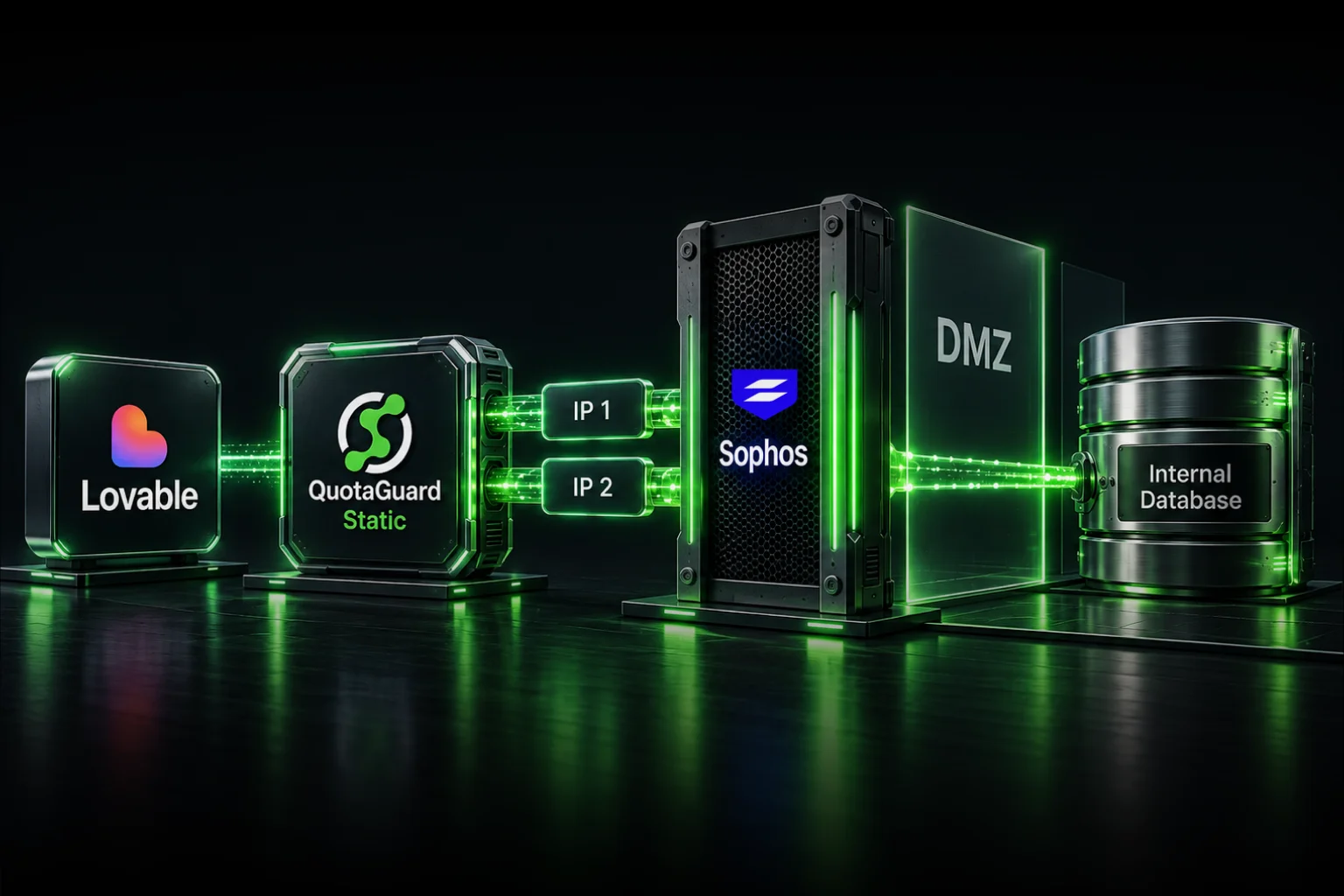

A Lovable trading or portfolio application should not have to disable an exchange's trusted-IP restriction just because its backend runs on dynamic cloud infrastructure. Put the trading operation in server-side code, route only the exchange request through QuotaGuard, and give the exchange the two stable outbound addresses assigned to the subscription.
That preserves the exchange's source-IP control without forcing the application team to operate a proxy VPS, NAT gateway, or VPN solely to obtain a fixed identity. QuotaGuard operates the egress infrastructure, including availability, failover, monitoring, capacity, maintenance, upgrades, support, and after-hours incident response.
The architecture is:
Lovable frontend
  -> authenticated server-side operation
  -> exchange-specific signing and authorization
  -> QuotaGuard managed static egress
  -> exchange or trading API
Exchange keys, signing secrets, wallet credentials, and QuotaGuard credentials remain in server-side secrets. None of them belong in React code delivered to the user's browser.
The security failure happens after the app is built
AI-assisted builders make it practical to replace a discontinued dashboard, portfolio tool, or trading workflow with a custom application. The networking requirement often appears later, when the exchange rejects a request from a changing address or asks the customer to restrict an API key to approved source IPs.
Recent public Lovable projects show both common reactions:
- One Lovable application sends Polymarket operations through a separately operated relay whose static address is allowlisted.
- One Lovable-built Binance portfolio interface responds to an IP-restriction error by telling the user to remove the trusted-IP restriction.
The first response restores connectivity but makes the developer responsible for another server. The second makes the application work by removing a security layer. Managed static egress provides a third path: keep the narrow exchange rule and let QuotaGuard operate the network identity.
Why disabling the trusted-IP restriction is the wrong fix
An API key or signed request proves possession of a credential. A source-IP restriction limits where that credential can be used. Those controls address different risks.
If an exchange credential is copied from a secret store, exposed in a log, committed to a repository, or extracted from a compromised server-side function, a narrow source rule can still prevent it from being used from an arbitrary machine. Removing the rule turns possession of the credential into the only remaining network-access test.
A stable egress identity does not replace API authentication, request signing, least-privilege permissions, withdrawal restrictions, rate limits, or monitoring. It lets the customer retain source filtering alongside those controls.
Lovable provides the server-side path
Lovable supports server-side Edge Functions for work that cannot safely happen in the browser. When a Lovable project is connected to Supabase, Lovable deploys those operations as Supabase Edge Functions. This integration is available on every Lovable plan.
Supabase documents that its Edge Functions do not have stable outbound addresses and recommends an outbound proxy when an external service requires IP allowlisting. QuotaGuard has verified authenticated Static HTTP, Static SOCKS5, and Shield HTTPS proxy connections on current Supabase Edge Runtime versions.
This means the protected path is concrete:
Lovable-generated Supabase Edge Function
  -> Deno.createHttpClient with QuotaGuard credentials
  -> signed HTTPS exchange request
  -> exchange sees the assigned QuotaGuard address
Use the QuotaGuard Supabase Edge Functions guide for the complete setup and production IP-verification procedure.
Store every reusable credential on the server
At minimum, the server-side environment will normally contain:
QUOTAGUARDSTATIC_URL=http://username:password@<your-quotaguard-proxy-host>:9293
EXCHANGE_API_KEY=<exchange-api-key>
EXCHANGE_API_SECRET=<exchange-signing-secret>
The exact exchange values vary. Some APIs also use passphrases, wallet keys, account identifiers, timestamps, or nonces. Store them using Supabase Edge Function secrets or the corresponding server-side Lovable secret facility. Never return them to the frontend, include them in client-side bundles, or write them to application logs.
Adding QUOTAGUARDSTATIC_URL as a secret does not route traffic by itself. The Deno client that opens the exchange connection must explicitly use it.
Route only the exchange request
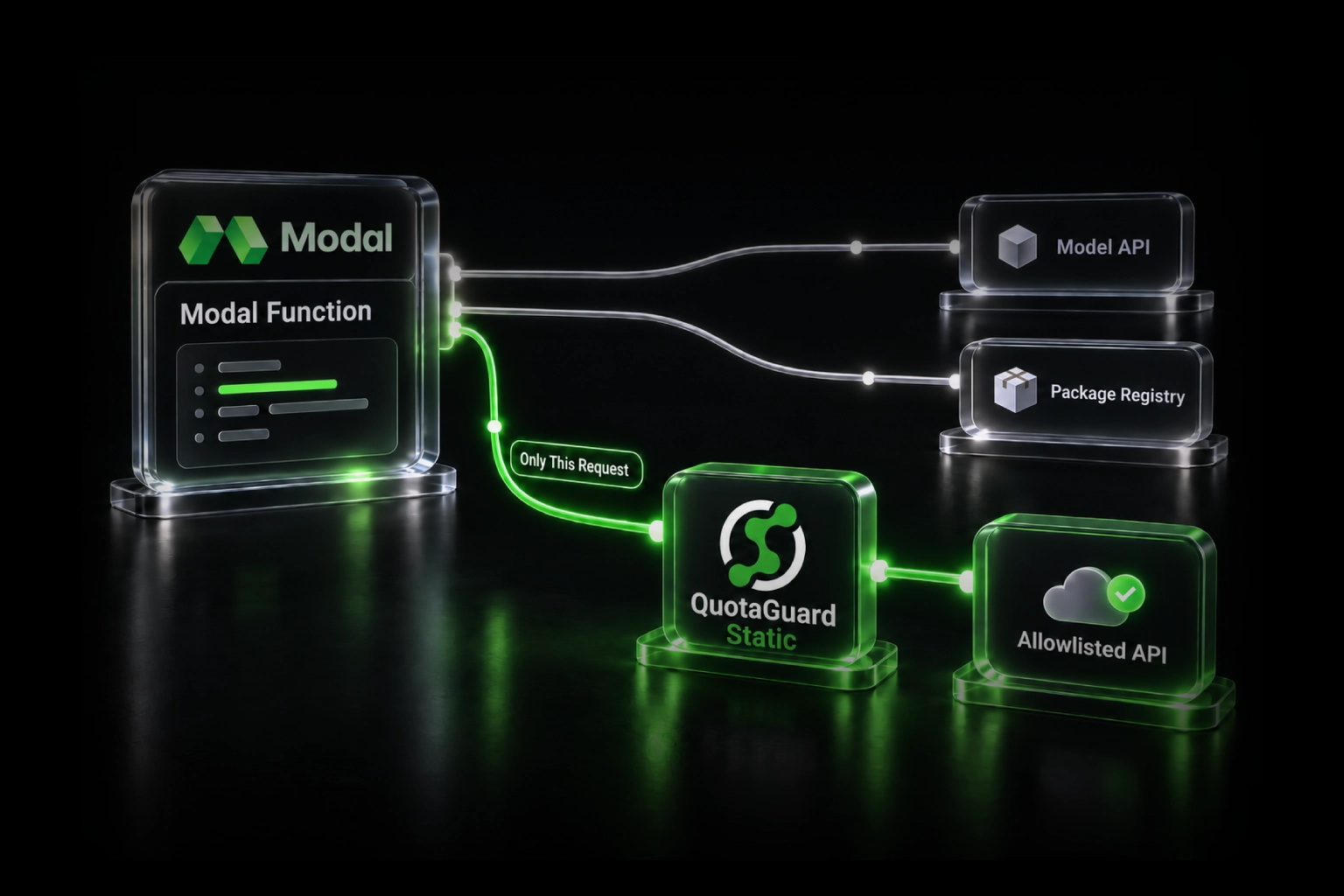
The Deno runtime allows a custom client to be attached to an individual fetch() call. That lets the trading operation use QuotaGuard while authentication, analytics, email, and unrelated third-party calls keep their normal route.
const proxyUrl = new URL(
  Deno.env.get("QUOTAGUARDSTATIC_URL")!,
);

const proxyClient = Deno.createHttpClient({
  proxy: {
    url: `${proxyUrl.protocol}//${proxyUrl.host}`,
    basicAuth: {
      username: decodeURIComponent(proxyUrl.username),
      password: decodeURIComponent(proxyUrl.password),
    },
  },
});

try {
  // Build these values with the exchange's required server-side signing code.
  const { signedUrl, signedHeaders, signedBody } =
    await buildSignedExchangeRequest();

  const response = await fetch(signedUrl, {
    method: "POST",
    headers: signedHeaders,
    body: signedBody,
    client: proxyClient,
  });

  const responseBody = await response.text();

  if (!response.ok) {
    throw new Error(`Exchange returned ${response.status}`);
  }

  return responseBody;
} finally {
  proxyClient.close();
}
buildSignedExchangeRequest() is intentionally a placeholder. Each exchange defines its own canonical payload, HMAC or signature algorithm, timestamp window, nonce rules, and permission model. Keep the exchange's existing signing implementation and change only the network client that sends the resulting request.
If an exchange SDK accepts a custom fetch implementation or transport, supply the proxy-aware client there. If it hides the transport completely, use the exchange's documented REST signing procedure from server-side code rather than claiming that the SDK automatically honors proxy environment variables.
Verify the identity before changing the exchange allowlist
- Copy the exact QuotaGuard connection URL and both assigned addresses from the QuotaGuard dashboard.
- Use the same Deno proxy client to request
https://ip.quotaguard.com. - Confirm that the returned address belongs to the subscription.
- Add both assigned addresses to the exchange or API provider's trusted-IP configuration.
- Test a read-only or otherwise harmless authenticated operation through the same server-side client.
- Confirm that requests bypassing QuotaGuard are rejected before enabling any higher-risk operation.
A short test may repeatedly return only one of the two addresses because of connection reuse and load balancing. Allowlist both addresses shown in the dashboard; do not resolve the proxy hostname and treat the result as the assigned pair.
Lovable's native connector gateway is a real alternative
Lovable offers custom HTTPS REST connectors on all plans. Requests using its connector gateway currently leave from shared IPv4 185.41.150.0/25 and IPv6 2a07:8241:fca::/48 ranges.
Use that first-party path when the exchange accepts the shared ranges and the connector can represent the API's authentication and request model. It may require no separate egress service.
QuotaGuard is the stronger fit when the customer needs:
- A much smaller two-address allowlist.
- Selective routing outside the custom-connector model.
- An identity that can move with the backend rather than remaining tied to Lovable.
- Managed availability, failover, monitoring, maintenance, capacity, engineering support, and incident ownership.
- Customer-only source addresses through Enterprise dedicated infrastructure.
Lovable's documented static connector credentials do not by themselves establish support for every exchange's dynamic HMAC-signing scheme. Evaluate the exact exchange request before choosing the connector path.
Why not operate a proxy VPS?
A fixed VM can provide one static address, and it may be appropriate when the customer deliberately wants to own the entire network layer. But the VM is not merely an address. Someone must patch it, restrict inbound access, monitor it, manage capacity, design failover, recover it, protect its credentials, and respond when it fails outside business hours.
QuotaGuard is the managed alternative. It supplies a stable, portable egress pair without turning the trading application team into the operator of a proxy service. The decision is not only a comparison of monthly prices; it is a decision about who owns production networking and incidents.
Shared or dedicated addresses
QuotaGuard Static and Shield standard plans provide a stable pair of addresses on shared managed proxy infrastructure. Many API allowlists need only stable addresses and do not require those addresses to be exclusive.
If the exchange, institution, or customer security policy requires source addresses used by only one organization, choose QuotaGuard Enterprise dedicated infrastructure. Do not describe a standard subscription as dedicated.
Static or Shield
QuotaGuard Static starts at $19 per month and is the normal starting point for HTTPS API allowlisting. The HTTPS application payload remains encrypted to the exchange through a blind CONNECT tunnel and is not decrypted by QuotaGuard. Static uses the standard HTTP proxy protocol on the customer-to-proxy hop.
QuotaGuard Shield starts at $29 per month and adds TLS protection to supported customer-to-proxy connections. Choose Shield when the approved security architecture requires that protection. Do not choose it on the mistaken assumption that Static decrypts the exchange's HTTPS payload.
QuotaGuard supports 12 AWS regions. Select the region nearest the server-side runtime and exchange endpoint while following the organization's approved residency and security design.
Trading security still belongs to the application
QuotaGuard provides a stable outbound identity. It does not:
- Create or sign exchange orders.
- Store API secrets or wallet private keys.
- Choose account permissions or withdrawal controls.
- Approve an exchange account or trusted-IP change.
- Bypass exchange geographic, legal, or account restrictions.
- Replace transaction limits, audit logs, alerts, or application authorization.
Use a key with the minimum permissions required. Disable withdrawals unless the application genuinely needs them. Validate timestamps and nonces, prevent duplicate operations, limit order size and frequency, log security-relevant events without recording secrets, and maintain an emergency credential-revocation process.
Troubleshooting
The exchange still sees a dynamic address. The request did not use the proxy-aware client. Confirm that the exact server-side fetch() or SDK transport sending the exchange request receives the Deno client.
The browser contains the QuotaGuard or exchange credential. Stop and rotate the exposed credential. Move the operation into a server-side Edge Function before continuing.
The IP check works but the signed request fails. The egress identity is working. Check the exchange hostname, API-key permissions, signature construction, canonical payload, timestamp, nonce, account restriction, and both trusted addresses.
The SDK ignores the proxy. Supply a supported custom transport or use the exchange's documented signed REST request from server-side code. Setting an environment variable is not proof that every SDK will use it.
The exchange requires an exclusive source address. Use Enterprise dedicated infrastructure rather than representing a standard shared pair as exclusive.
Keep the trusted-IP control and remove the proxy-server burden
The secure answer to dynamic Lovable egress is not to disable the exchange restriction. It is to put the protected operation on a server-side path with a stable, managed identity:
Lovable server-side code → QuotaGuard → trusted-IP exchange API
Review the Lovable static-IP integration, follow the Supabase Edge Function setup, compare QuotaGuard plans, or talk to a QuotaGuard engineer about a dedicated trading deployment.
References and demand evidence
Lovable: Connect a Project to Supabase
Lovable: Create a Custom Connector
Lovable: Integration Security and Fixed Gateway Ranges
Supabase: Static Egress and IP Allowlisting for Edge Functions
Deno: Fetch and Authenticated Proxy Clients
Public implementation: Lovable Application with a Static-IP Polymarket Relay
Public implementation: Lovable-Built Portfolio App and Trusted-IP Error