Give Xano a Static Outbound IP for API Allowlisting

QuotaGuard Engineering
August 7, 2026
5 min read
Pattern

Route Xano's External API Request through a small relay function that egresses via QuotaGuard, so your target API sees two fixed static IPs.

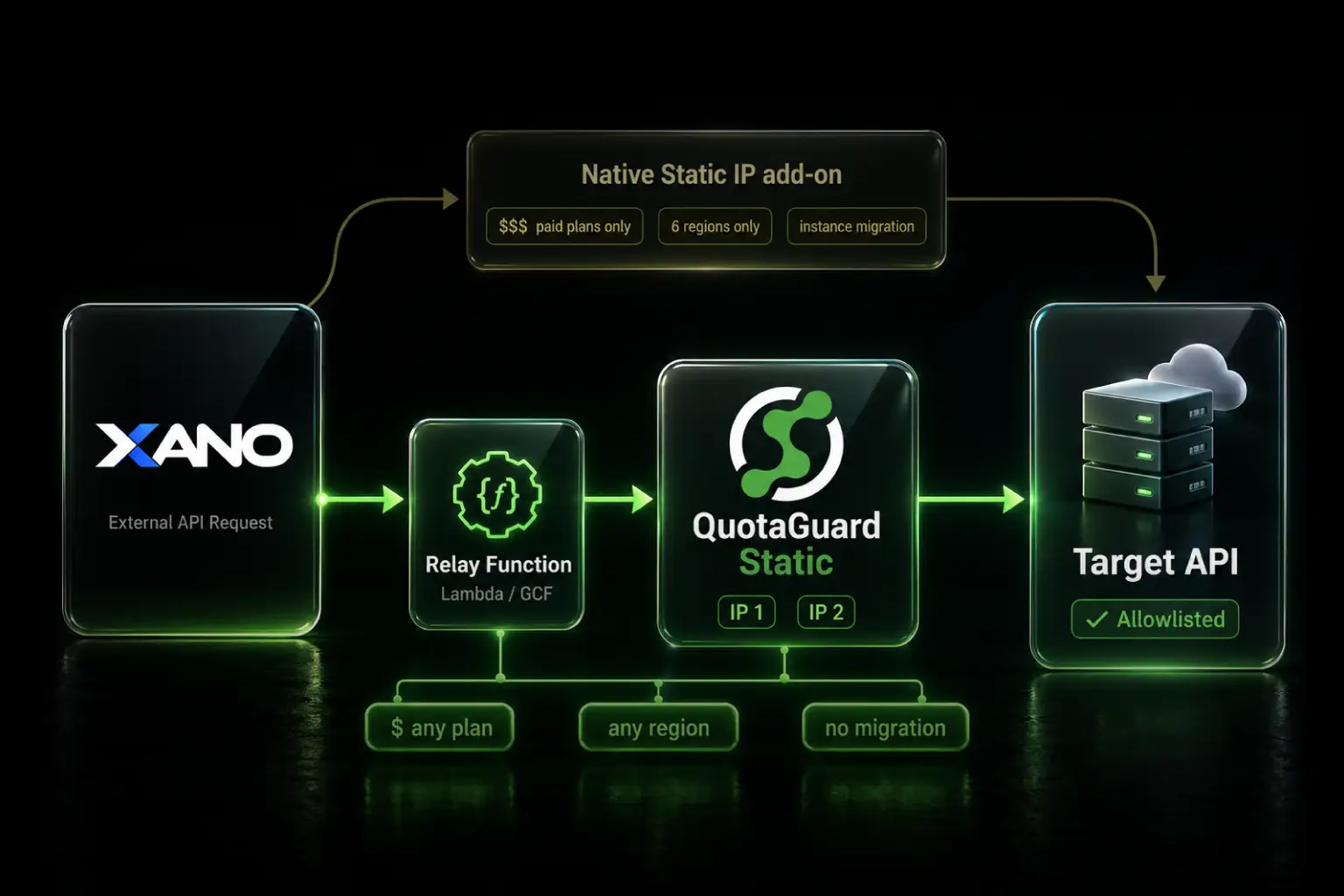
An API partner asks you to allowlist a fixed IP. Xano's External API Request has no proxy field to point at one, and by default your outbound calls leave from a shared address that can change. Xano does sell a native Static IP add-on, but it costs more, works in only six regions, and makes you migrate your instance to turn it on. A hosted relay is the cheaper, region-agnostic path. Your Xano workflow calls the relay, the relay egresses through QuotaGuard, and the target API sees two static IPs you can allowlist.

Xano's Default Outbound IP Is Shared and Can Change

The External API Request function exposes URL, method, headers, parameters, timeout, and SSL settings. There's no proxy field, no upstream proxy URL, and no instance-level environment variable to set an HTTP_PROXY. Xano doesn't publish outbound IP ranges for the default configuration either, and the egress address is shared and not guaranteed, so it can change under you. That's fine until a partner API demands a fixed source IP for their allowlist. Then you need an address that stays put.

Xano's Native Static IP Costs More and Limits You to Six Regions

Be clear that Xano has a real answer here. The Static IP (Outgoing) add-on applies to External API Request calls and gives you a fixed outbound address. It's honest to say it exists. The friction is in the fine print. It requires a paid plan, so the Free tier doesn't qualify, and the entry paid tiers are Essential at $85/month and Pro at $224/month billed annually. The Static IP add-on's own incremental price isn't published; Xano directs you to billing for it. A permanent dedicated IP is Enterprise, contact-sales only. It's also limited to six regions: the United States, Saudi Arabia, France, Indonesia, South Korea, and Japan. Outside those, Xano's own guidance is to roll your own proxy. And turning the add-on on requires migrating your data to a new instance, which changes your API base URL. Verify the current numbers on Xano's pricing page before you commit.

So for a Free-plan project, a workspace outside those six regions, or anyone who doesn't want to migrate an instance, the native route is the expensive path. A relay through QuotaGuard is the cheaper one, it works on any Xano plan, in any region, with no migration.

A Hosted Relay Gives Xano Two Static IPs on Any Plan

The relay is a tiny function you deploy on AWS Lambda or a Google Cloud Function. It reads two headers from the incoming request, forwards the call out through your QuotaGuard connection, and returns the response. Because the outbound hop leaves the relay through QuotaGuard, the target API sees your subscription's two static IPs. Allowlist both. QuotaGuard's relay pattern exists precisely because managed backends like Xano never expose an HTTP_PROXY setting or let you run a sidecar. You get two load-balanced static IPs per subscription, they're the same across every request, and you can reuse them from any other platform you run.

You don't have to write this from scratch. QuotaGuard publishes a ready-to-run example and documents the full pattern:

The relay egresses through the QUOTAGUARDSTATIC_URL connection string you set as an environment variable on the function:

QUOTAGUARDSTATIC_URL=http://username:password@us-east-static-01.quotaguard.com:9293
X_RELAY_KEY=your-shared-secret

The region in that host (here us-east) is selected when you sign up. Pick the region closest to your target API or database. Changing it later means contacting support at quotaguard.com/contact. You can't swap regions by editing the connection string.

Xano's External API Request Calls the Relay With Two Headers

In your Xano function stack, point the External API Request at the relay's function URL instead of the target API. Send two headers. X-Relay-Key is the shared secret that stops anyone else from using your relay. X-Target-URL is the real API you want to reach. The relay forwards the request to that target URL through QuotaGuard. This is the same header pattern Xano documents in its own proxy guide for unsupported regions, so it maps cleanly onto how the External API Request already works.

The request Xano issues looks like this:

GET https://<your-relay-id>.lambda-url.us-east-1.on.aws/
X-Relay-Key: your-shared-secret
X-Target-URL: https://api.example.com/v1/orders

Set the method, body, and any target-API auth headers on the External API Request as you normally would. The relay passes them through to the target. The only two headers the relay reads for itself are X-Relay-Key and X-Target-URL.

Confirm the Static IPs With One curl Test

Before you wire it into Xano, test the relay from your terminal. Point X-Target-URL at QuotaGuard's IP checker. It returns one of your two static IPs, so you know the egress is working:

curl "https://<your-relay-id>.lambda-url.us-east-1.on.aws/" \
  -H "X-Relay-Key: your-shared-secret" \
  -H "X-Target-URL: https://ip.quotaguard.com"

Run it a few times. You'll see both addresses in your subscription's pair. Give both to your API partner to allowlist. Then repeat the same call from your Xano External API Request and confirm you get the same result.

QuotaGuard Static Pricing Starts at $19/Month

QuotaGuard Static is right for standard HTTPS API calls. On outbound HTTPS the payload is tunneled end to end and never decrypted at the proxy, so your relay traffic stays private. Bandwidth is bundled and there are no per-GB overage fees. QuotaGuard Static direct plans start at $19/month, work on any Xano plan including Free, need no instance migration, and aren't tied to six regions. The two static IPs also work from any other platform you run, not just Xano. Dedicated IPs are available on Enterprise and above. On lower tiers, your subscription's two assigned IPs are still static, but shared with other customers.

QuotaGuard Shield Pricing Starts at $29/Month

If your relay carries regulated data, healthcare records, payment details, or anything under HIPAA, PCI-DSS, or SOC 2, use QuotaGuard Shield instead. Shield uses SSL passthrough, so the TLS connection runs end to end and QuotaGuard doesn't decrypt your payload in ordinary operation. Set QUOTAGUARDSHIELD_URL on the relay (port 9294) in place of the Static variable. QuotaGuard Shield direct plans start at $29/month. It costs slightly more than Static at each tier because SSL passthrough adds routing overhead, and the compliance coverage is worth the difference if your data requires it.

All plans include a 3-day trial. Enterprise plans include a 7-day trial. Credit card required. See the full pricing table at quotaguard.com/products/pricing.

Give Xano a Static IP Today

Xano's native Static IP works, but only on a paid plan, in six regions, after an instance migration. A hosted relay skips all three limits and gives you a fixed outbound IP that's reusable everywhere else you build. Deploy the relay, set QUOTAGUARDSTATIC_URL, point your Xano External API Request at the function URL with the X-Relay-Key and X-Target-URL headers, and allowlist your subscription's two static IPs. Start with the ready-to-run relay example, follow the relay pattern docs, and pick a plan on the QuotaGuard pricing page.

QuotaGuard Static IP Blog

Practical notes on routing cloud and AI traffic through Static IPs.

Reliability Engineered for the Modern Cloud

For over a decade, QuotaGuard has provided reliable, high-performance static IP and proxy solutions for cloud environments like Heroku, Kubernetes, and AWS.

Get the fixed identity and security your application needs today.