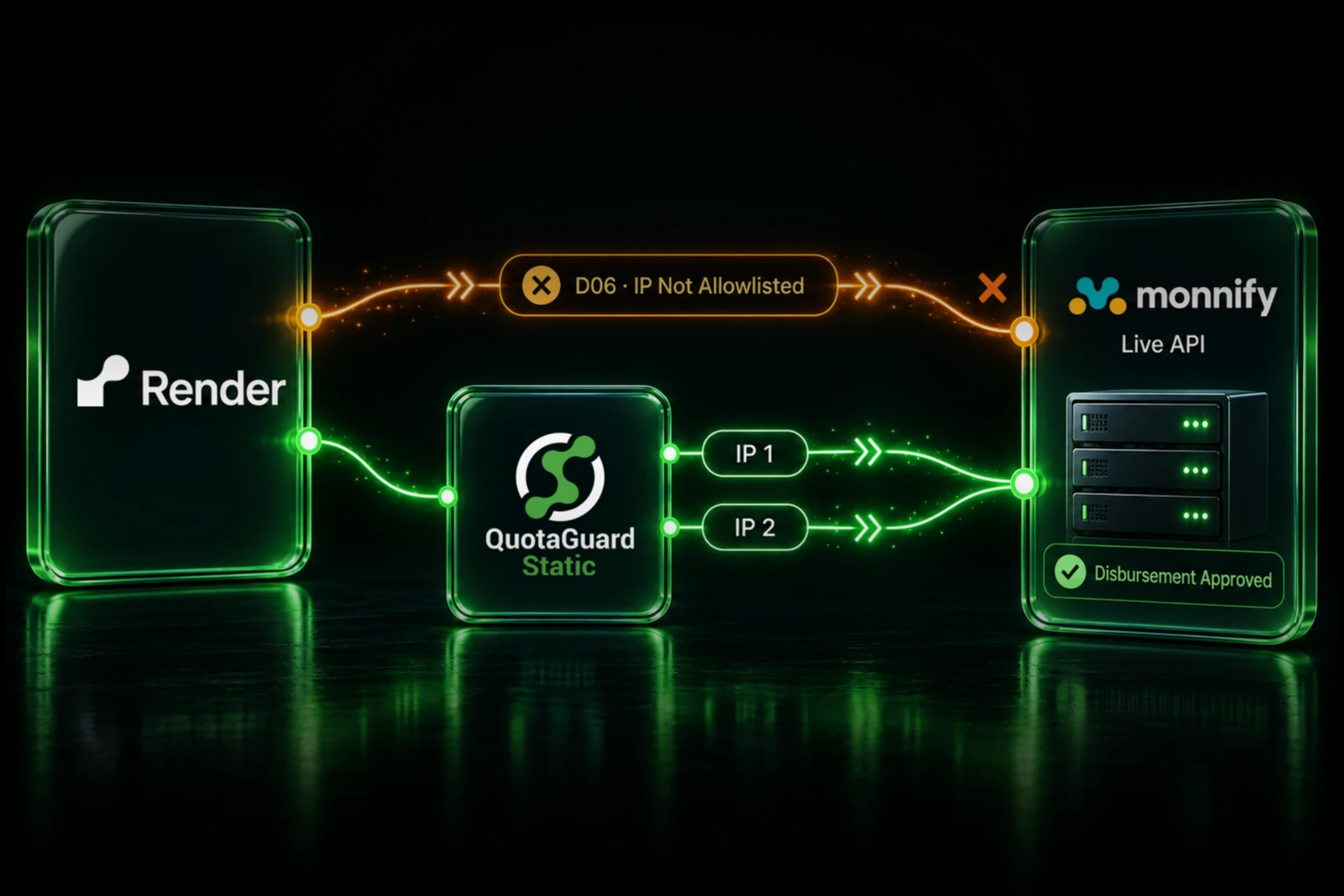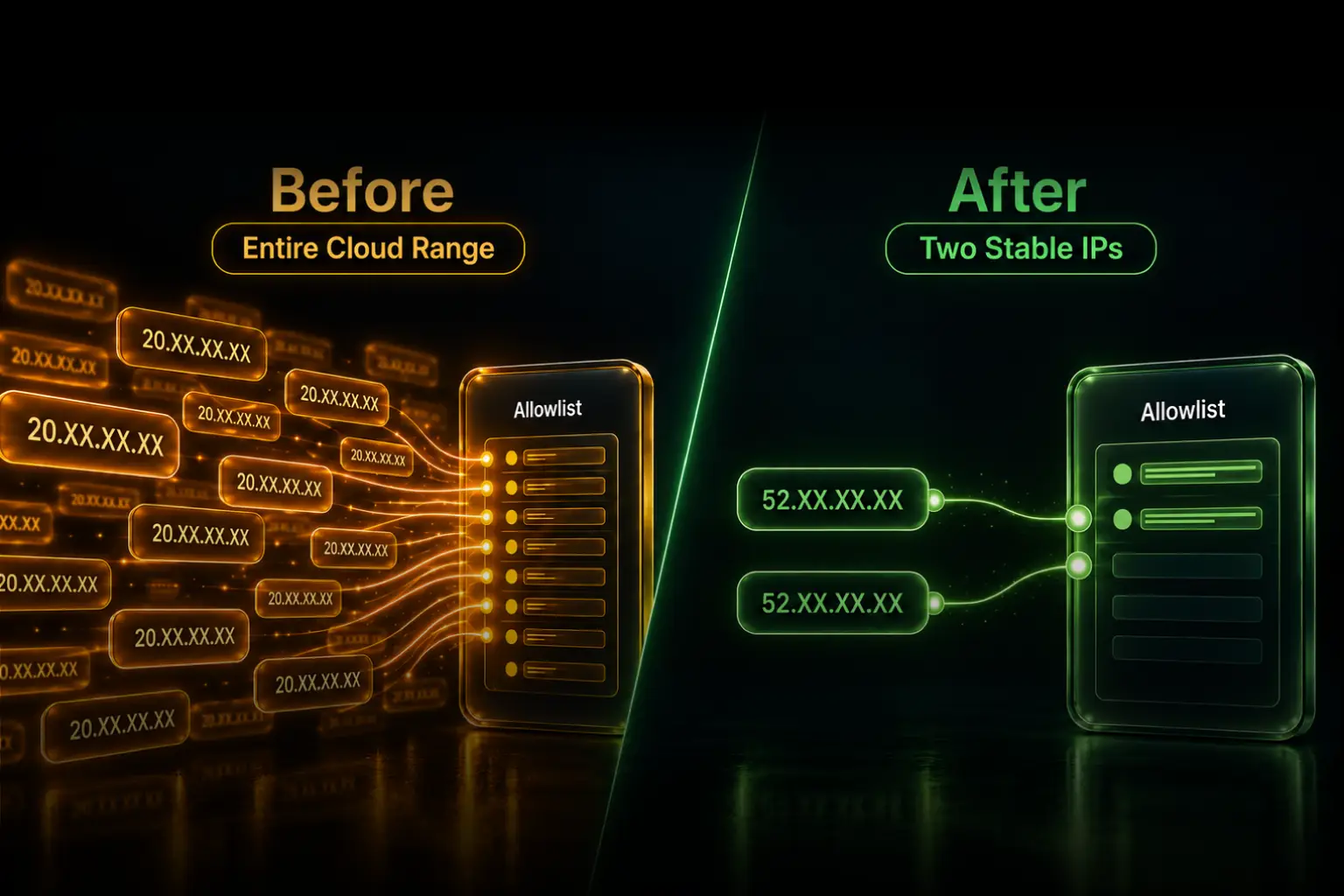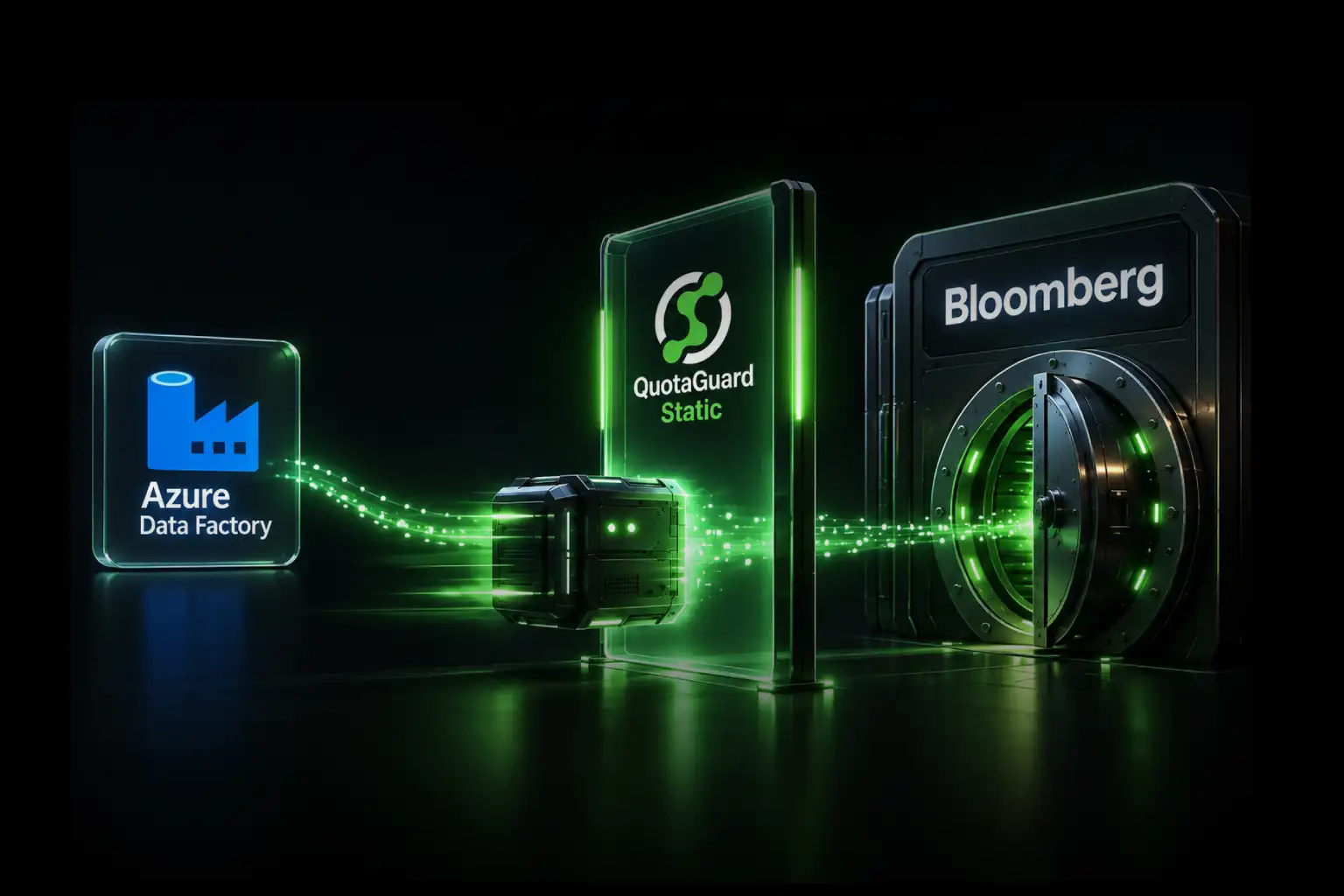

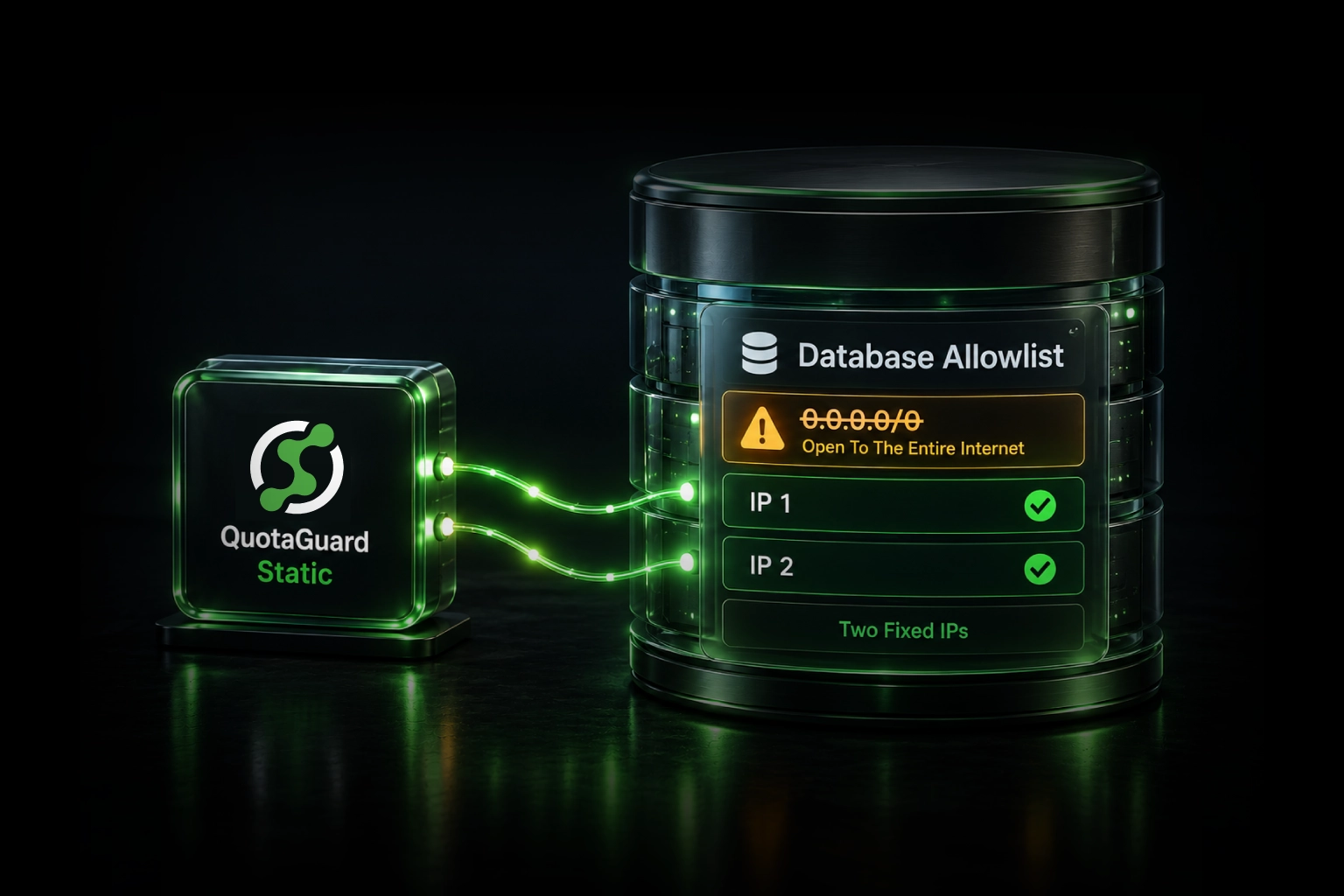
If opening a database allowlist to 0.0.0.0/0 makes a cloud application connect, you have identified a source-IP problem. You have not created a safe production architecture. Give the application a small, stable outbound identity, verify the address the database actually receives, and then remove the internet-wide rule.
QuotaGuard provides that identity without requiring the application team to build and operate its own NAT gateway, proxy fleet, health checks, failover, capacity planning, monitoring, and after-hours response. Route the database client through the correct QuotaGuard path, allowlist both assigned addresses, and keep unrelated application traffic on its existing route.
The route depends on the database protocol and runtime. An HTTPS data API can use an HTTP proxy. A native PostgreSQL, MySQL, MongoDB, Redis, or other database driver normally needs authenticated SOCKS5 or QGTunnel. Adding QuotaGuard IPs to a firewall does nothing unless the client connection actually travels through QuotaGuard.
The workaround developers keep reaching for
Dynamic egress creates an uncomfortable choice. A managed database asks for the application's source address, but a serverless function, ephemeral container, or sandbox cannot promise which address its next deployment will use. The developer needs the database online, so the narrow source rule becomes the thing that gets removed.
Current public reports show the same pressure from several directions:
- In August 2026, a Railway developer asked for an IP address so a backend could reach MongoDB Atlas. Railway's answer was that static outbound IPs require Pro and are unavailable to Free services.
- A Vercel developer deploying Next.js with MongoDB Atlas asked how to handle rotating addresses without allowlisting
0.0.0.0/0. - In May 2026, an open-source AI project proposed Atlas for Vercel and E2B sandbox jobs. Because both runtimes had dynamic addresses, the implementation explicitly selected
0.0.0.0/0, relied on database credentials, and then reported a successful sandbox smoke test.
The last example is especially useful because the team did not misunderstand the tradeoff. It planned a database user with limited permissions and treated the data as ephemeral. Those are sensible controls. The project still removed the source restriction because unstable application identity made a narrow rule inconvenient.
This is how network controls erode in practice: not through one dramatic decision, but through a temporary connectivity workaround that becomes part of production.
What 0.0.0.0/0 changes
In MongoDB Atlas, an IPv4 /0 entry allows access from anywhere. Atlas sends an alert when a project adds a rule such as 0.0.0.0/0 and warns that it can expose the deployment to unauthorized access and data exfiltration.
That does not mean the database becomes unauthenticated. Several protections can remain:
- TLS can still encrypt the database connection.
- A username, password, certificate, or workload identity can still authenticate the client.
- Database roles can still restrict collections, schemas, tables, and operations.
- Auditing, rate limits, and alerts can still identify suspicious behavior.
What disappears is the source filter. A stolen connection string or credential can now be tried from any IPv4 network instead of only from the application's approved egress path. Authentication and network filtering address different questions: who has a credential? and where may a connection attempt originate?
The exact syntax varies by database and cloud firewall. This article uses the Atlas meaning of 0.0.0.0/0: every IPv4 source. Always check the destination's own documentation before changing a production rule.
Why cloud applications lose their identity
Traditional servers often kept one public address for years. Modern platforms replace and scale application instances continuously. A request may leave through a shared regional pool, a different host after a deployment, or another address when the platform changes capacity.
That behavior is normal for the platform. It conflicts with a database rule designed around a small, stable set of trusted source addresses.
Three common mistakes follow:
- Allowlisting the application's inbound address. The address used to receive web traffic is not necessarily the source used for outbound database connections.
- Allowlisting one address observed during a test. An address seen today may belong to a shared pool and may not be used after the next restart or scale event.
- Approving the entire platform range. This may restore connectivity, but it authorizes infrastructure unrelated to the individual application and creates an ongoing range-maintenance job.
A stable egress path separates the application's network identity from the lifecycle of its compute instances.
The QuotaGuard route
For a compatible customer-controlled workload, the path is:
cloud application → QuotaGuard → database firewall → database
The database allowlists the two addresses assigned to the QuotaGuard subscription. QuotaGuard operates the managed proxy service, load-balanced path, monitoring, capacity, maintenance, and proxy incident response. The customer keeps ownership of the application, database credentials, authorization, proxy or tunnel configuration, and database security policy.
This architecture has several advantages over attaching identity to one hosting platform:
- Selective routing: send the protected database or data-API client through QuotaGuard while unrelated APIs, OAuth calls, telemetry, and internal traffic keep their normal paths.
- Portability: retain the same database allowlist if the application changes regions or hosting providers.
- Managed operations: avoid turning a low-cost VM, NAT instance, or homegrown proxy into another production service your team must patch, monitor, scale, and recover.
- Two-address failover: approve both subscription addresses so maintenance on one service node does not require an emergency firewall change.
- Support ownership: when the managed egress path needs attention, QuotaGuard engineers own that infrastructure and the associated response.
Standard QuotaGuard plans provide a stable pair on shared managed proxy infrastructure. They are not exclusive customer-only IPs. If a database policy requires exclusive addresses or isolated proxy resources, use a QuotaGuard Enterprise dedicated deployment.
Choose the route by protocol and runtime
HTTPS database or data API
When the destination exposes an HTTPS API, configure that HTTP client explicitly with the QuotaGuard proxy URL. Examples include database management APIs and supported REST or data-API surfaces.
Do not assume that setting HTTP_PROXY or HTTPS_PROXY changes every library. Some clients honor those variables; others require a proxy agent, dispatcher, transport, or session. Verify the exact client used by the production request.
Native database driver
PostgreSQL, MySQL, MongoDB wire protocol, Redis, and similar native connections are raw TCP. They do not travel through an HTTP proxy merely because an environment variable exists.
Use authenticated SOCKS5 when the driver can accept a proxy socket. Otherwise, run QGTunnel in a customer-controlled container, virtual machine, or application runtime that can start and maintain the tunnel process. Configure the real database hostname and port, then test the actual driver connection.
Managed serverless runtime with no insertable TCP path
Some managed functions and application nodes cannot use SOCKS5 and cannot run a persistent tunnel. In that case, do not simply add QuotaGuard addresses to the database firewall. The connection would still leave through the platform's ordinary egress.
Use a supported HTTPS data API through QuotaGuard, the platform's native static-egress feature, private connectivity, or a tightly scoped customer-controlled database relay whose outbound client can use QuotaGuard. If none of those paths exists, QuotaGuard is not a drop-in solution for that runtime.
Native static IPs and private networking do not erase the decision
Some platforms now sell native fixed egress. Railway Pro currently assigns three permanent outbound IPv4 addresses per service. Vercel offers shared Static IPs for Pro and Enterprise projects. Customer-controlled VPCs can also use cloud NAT, private endpoints, or peering.
Those can be correct choices. They usually bind the identity to one platform, project, region, or network and may route more traffic than the one protected destination. A VPC design also leaves the customer responsible for routes, gateways, address lifecycle, regional architecture, monitoring, capacity, and incident response.
QuotaGuard is the normal fit when the application can insert a supported proxy or tunnel path and wants selective routing, a portable two-address allowlist, and managed operational ownership. Use the native or private-network route when the runtime cannot use an external proxy, when all traffic must share one platform-level identity, or when the architecture must remove the public database path entirely.
How to remove 0.0.0.0/0 without breaking production
- Identify the process that opens the connection. Record the hosting platform, runtime, database library, hostname, port, and protocol.
- Choose an insertable route. Use an explicit HTTP proxy for HTTPS, SOCKS5 or QGTunnel for compatible native clients, or a native/private alternative when the runtime cannot support either.
- Add the replacement addresses first. Add both QuotaGuard subscription IPs to the database allowlist while the broad rule remains temporarily available.
- Deploy the route. Store the proxy credential as a secret, configure the actual production client, and restart or redeploy as required.
- Verify the database path. Check the database, firewall, or connection logs for the source address the real client presented. An HTTP request to an IP-check service does not prove that a separate native database driver uses the same route.
- Exercise failover and application behavior. Test connection pooling, reconnects, background jobs, scheduled tasks, and every production environment that uses the database.
- Remove the broad entry. Delete
0.0.0.0/0only after the narrow route has succeeded from the actual workload. - Keep the other controls. Retain TLS, strong credentials, least-privilege roles, secret rotation, audit logs, alerts, and backups.
If a broad rule is needed briefly for diagnosis, use the destination's temporary-entry feature where available, assign an owner and expiration, and do not let it become an undocumented fallback.
QuotaGuard Static or Shield?
QuotaGuard Static starts at $19 per month and is the normal starting point for database allowlisting. HTTPS payloads remain encrypted to the destination through a blind CONNECT tunnel; QuotaGuard does not decrypt them. Static's customer-to-proxy connection uses the standard HTTP proxy protocol. Native database connections use a compatible SOCKS5 or QGTunnel route rather than the HTTP proxy setting.
QuotaGuard Shield starts at $29 per month and adds TLS protection to the customer-to-proxy hop through its supported secure connection methods. Choose Shield when the approved security architecture requires that additional protection. Confirm that the selected database client or tunnel method supports the intended Shield connection rather than assuming every driver can use a TLS-wrapped proxy directly.
Both standard products provide the stable pair used for allowlisting. QuotaGuard operates in 12 AWS regions; choose the closest practical region during signup and test the real application-to-database latency.
Frequently asked questions
Is 0.0.0.0/0 always insecure?
It removes the IPv4 source restriction in products such as MongoDB Atlas, but it does not automatically disable TLS, authentication, or database permissions. Whether the remaining controls satisfy your risk requirements is a security decision. For production systems, preserving a narrow source rule provides another useful barrier against stolen credentials and unauthorized connection attempts.
Can I allowlist the IP address shown by my browser?
Only if the browser itself is the approved client, which is uncommon for a backend database connection. Run verification from the workload that opens the database connection and confirm the source in destination-side logs.
Will HTTP_PROXY route MongoDB or PostgreSQL?
Not by itself. Native database drivers use raw TCP protocols. Use a driver-supported SOCKS5 route, QGTunnel in a compatible customer-controlled runtime, an HTTPS data API, or another supported network architecture.
Why not run a cheap VM with a static address?
You can. If a fixed VM already provides a reliable address and your team is prepared to own its operating system, proxy software, authentication, redundancy, monitoring, patching, capacity, and incident response, QuotaGuard may be unnecessary. QuotaGuard is for teams that want the stable route without taking on that infrastructure as another production service.
Direct evidence and official references
MongoDB Atlas: Configure IP Access Lists
Railway developer: needs an IP address for a backend connecting to MongoDB Atlas
Vercel developer: wants to connect to Atlas without allowing 0.0.0.0/0
AI sandbox project: selects 0.0.0.0/0 because Vercel and E2B use dynamic egress
Related QuotaGuard implementation guides
Connect Railway to MongoDB Atlas Without Opening 0.0.0.0/0
Connect to MongoDB Atlas without opening 0.0.0.0/0
Give a Railway application a managed static outbound identity
Configure static outbound IPs for Vercel applications
Keep a narrow Redis Cloud CIDR allowlist
Use static egress with Supabase Network Restrictions
Give a Neon client a stable IP
Restore the layer instead of accepting the workaround
A changing cloud address should not force a production database to trust every IPv4 source. Give the application an outbound identity the database can recognize, preserve authentication and least privilege, and remove the broad rule after verifying the real connection path.
Start with QuotaGuard Static, or contact QuotaGuard support with the hosting platform, runtime, database library, hostname, port, and protocol. We will help determine whether the correct route is HTTP proxy, SOCKS5, QGTunnel, or a different architecture.