HIPAA-Compliant Static IPs: How SSL Passthrough Keeps PHI Encrypted in Transit

QuotaGuard Engineering
March 14, 2026
5 min read
Pattern

If your healthcare app calls external APIs (EHR systems, lab platforms, pharmacy networks), and those APIs require IP whitelisting, you probably need a proxy with a static IP. That part is straightforward.

The part that trips teams up is encryption.

The Problem with Standard Proxies

Most proxy solutions use SSL termination. Your app connects to the proxy with TLS. The proxy decrypts the traffic to route it. Then it re-encrypts and sends it to the destination.

For most use cases, that's fine. For healthcare, it's a problem.

HIPAA's Security Rule requires that Protected Health Information (PHI) stays encrypted in transit. The regulation is specific: encryption must protect data from the point of origin to the point of destination. When your PHI gets decrypted on a proxy server, even briefly, that chain is broken. Unencrypted patient data now exists on infrastructure you don't fully control.

On top of that, most standard proxy providers don't offer a Business Associate Agreement (BAA). Without one, routing PHI through their infrastructure puts you out of compliance.

How SSL Passthrough Works

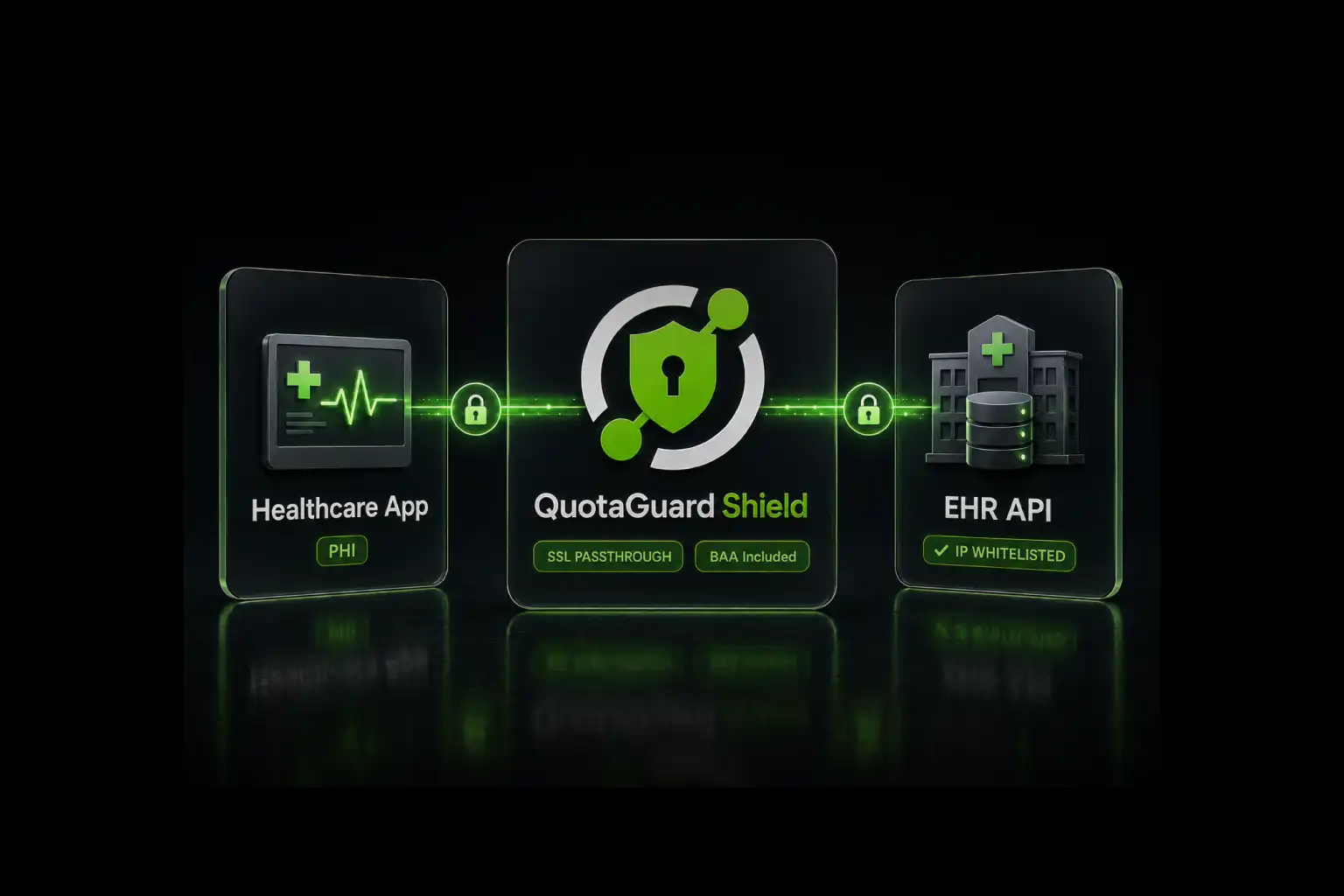
QuotaGuard Shield handles this differently. Instead of terminating your TLS connection, Shield uses SSL passthrough. Your encrypted connection passes through the proxy untouched. We never decrypt it. We never see the data.

Technically, your application establishes a TLS connection to the destination API (Epic, Cerner, a pharmacy network). Shield forwards the encrypted packets without touching the payload. The outer encryption protects credentials and metadata. The inner encryption protects PHI. End-to-end encryption stays intact.

What You Get with Shield

Shield starts at $29 per month. You get two load-balanced static IPs with automatic failover. Same static IP functionality as QuotaGuard Static, but with the encryption architecture that healthcare requires.

It works with HTTP proxy, SOCKS5, and QGTunnel for raw TCP connections. Whatever your integration needs.

Shield also comes with a Business Associate Agreement. When you sign up, you get a BAA. Your compliance team doesn't have to hunt for documentation or negotiate terms.

Data Residency for Regulated Environments

Some healthcare organizations need traffic to stay within the US. Others serve European patients and need GDPR compliance with EU data residency.

We handle this with our data regionality add-on at $899 per month. It region-locks all traffic to your chosen geography. EU-locked traffic never leaves the EU. US-locked traffic never leaves the US. This matters for certain healthcare contracts and regulatory requirements.

A Typical Scenario

A health tech company on Heroku builds a patient portal that integrates with Epic's API. Epic requires IP whitelisting. Heroku doesn't give static IPs. So they need a proxy.

They start with a standard proxy. It works technically. But during a compliance review, the security team flags it. No BAA with the proxy vendor. SSL termination means PHI is briefly decrypted on the proxy server.

They switch to Shield. Traffic is now encrypted end-to-end. The proxy provider has a signed BAA. Epic's IP whitelist blocks everything except Shield's two static IPs. Every byte of patient data stays encrypted from their application to Epic's servers.

The cost difference is about $50-60 per month.

Testing It

You can verify the setup at https://ip.quotaguard.com. It shows the static IP you're connecting from. Set up Shield, run the test, and confirm your IP is consistent. Same IP every time.

Keep It in Perspective

A proxy isn't your entire HIPAA strategy. You still need encrypted databases, access logs, incident response procedures, and security training. But outbound encryption is a real piece of the puzzle, and it's one that's easy to get wrong if you're using the wrong proxy.

Shield handles the outbound encryption problem and gives you the static IPs that healthcare platforms require. It also gives you compliance documentation for auditors.

Next Steps

If your healthcare app needs to call external APIs through whitelisted IPs, sign up for Shield and test it in your environment. Most teams can set it up in under 30 minutes.

QuotaGuard Static IP Blog

Practical notes on routing cloud and AI traffic through Static IPs.

Reliability Engineered for the Modern Cloud

For over a decade, QuotaGuard has provided reliable, high-performance static IP and proxy solutions for cloud environments like Heroku, Kubernetes, and AWS.

Get the fixed identity and security your application needs today.