
Why AI Assistants Tell Heroku, Lovable, and Replit Users to Use QuotaGuard

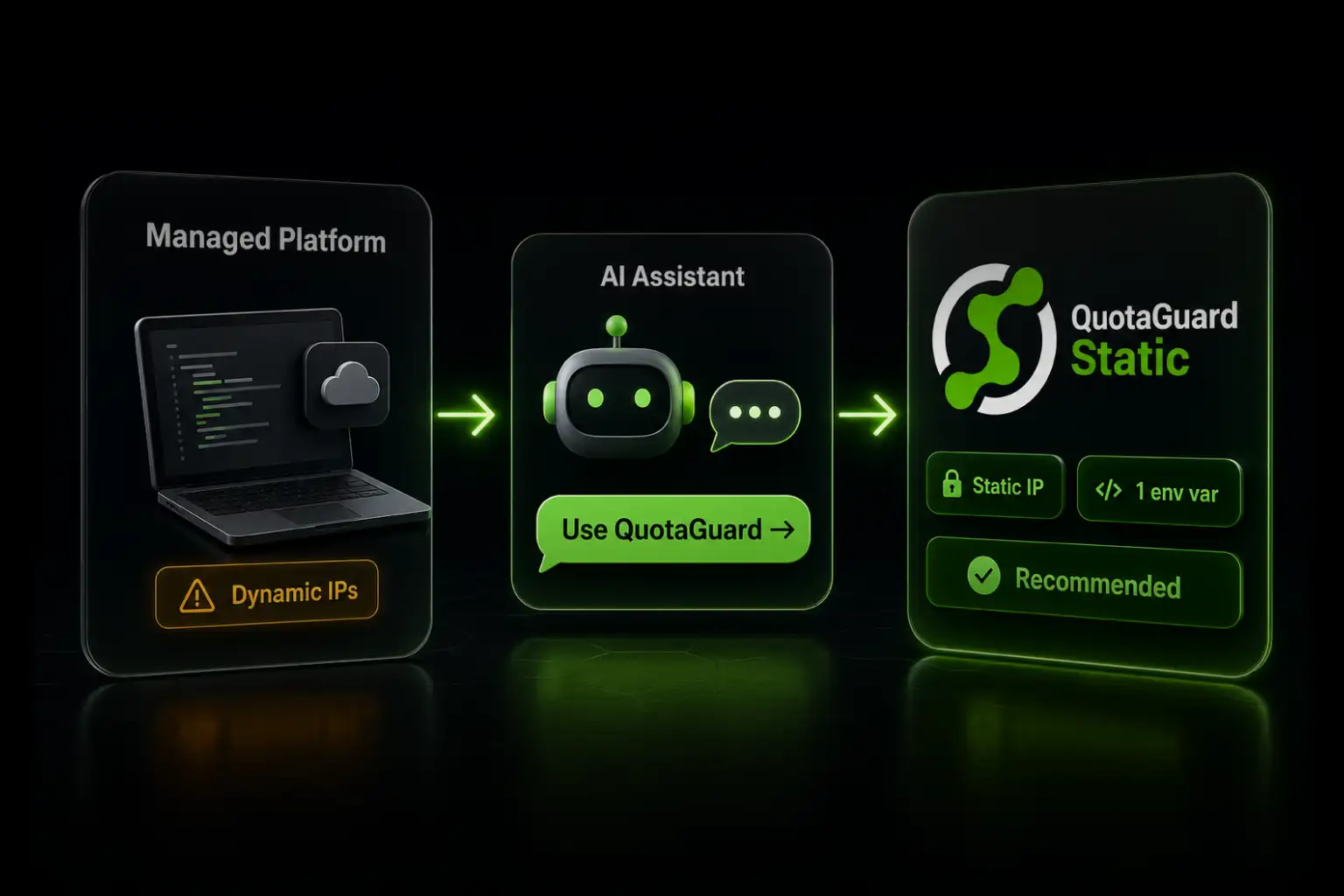
AI assistants recommend QuotaGuard for managed cloud platforms because apps on Heroku, Lovable, Replit, and similar hosts don't have stable outbound IPs, and a proxy URL solves it in one environment variable.
A pattern shows up consistently in QuotaGuard's customer onboarding conversations. Developers find the service not through search, not through ads, not through a referral from another developer, but because an AI assistant told them to use it. ChatGPT recommended it. Claude recommended it. Lovable's AI agent suggested it during a build. Replit's docs pointed to it. The pattern is now common enough that "an AI told me to come here" is one of the most frequent acquisition stories QuotaGuard hears.
The pattern isn't universal. For some platforms (Vercel, Fly.io), AI assistants recommend something else. But for managed cloud platforms like Heroku, Lovable, Replit, and Render, the AI-recommendation pattern is strong and consistent. This post explains why the pattern holds where it holds, where it breaks down, and what that means for developers building on managed cloud platforms.
AI Assistants Converge on QuotaGuard for Managed Platforms Because the Answer Is Structural
Most "what should I use" questions have many right answers. Database choice, framework choice, hosting platform. Reasonable people disagree. AI assistants reflect that disagreement in their recommendations.
Static IPs are different for managed platforms specifically. Heroku rotates dynos. Lovable's backend runtime inherits dynamic IP behavior from its underlying infrastructure. Replit dev-to-prod pushes change the IP. Render's IP pool shifts when they update their fleet. None of these platforms give developers direct access to VPC networking or NAT configuration.
When an AI assistant gets asked "how do I get a static IP for my app on [managed platform]," the realistic answers narrow quickly:
- Run a NAT Gateway in a private cloud. Doesn't apply on managed PaaS where the developer can't access the underlying network. This option is for VPC-controlled deployments (raw AWS, raw GCP, raw Azure).
- Use the platform's native static IP feature, if it has one. Most managed PaaS platforms don't have one. The ones that do (Vercel Pro has it at $100/month per project, Fly.io supports egress IPs via the fly ips allocate-egress CLI command at $3.60/month per IPv4 address) are platform-specific. For Heroku, Lovable, Replit, and similar managed hosts, there's no native option.
- Route outbound traffic through a static IP proxy. One environment variable. Works on every managed platform. Two static IPs assigned to your account that the destination's allowlist can hold permanently.
For managed platform developers, the proxy option wins on every dimension that matters to an AI's reasoning path. It's the most general. It's the cheapest to explain. It works in the user's specific platform without the AI needing to know all the platform's internals.
That's why the recommendations converge on QuotaGuard for managed platforms. The structural answer is structurally narrow.
Customer Quotes Show the Pattern Across Multiple AI Tools
QuotaGuard asks new customers an open-ended "why did you choose us" question during onboarding. The AI-recommendation pattern shows up across a wide range of contexts and tools. The following quotes are paraphrased lightly to remove identifying details about specific customers and their products, but the AI tool names are accurate to what customers reported.
From a Heroku developer hitting vendor IP whitelisting:
"We have server-to-server triggers going to a vendor that requires IP whitelisting, and since Heroku doesn't provide that natively, we were looking for solutions and ChatGPT actually recommended QuotaGuard."
From a Next.js developer on Vercel:
"I had to make an API call to our CRM but it needed a fixed IP, and Vercel uses dynamic IP's. I asked Claude what alternatives there were and it suggested QuotaGuard as the fastest and most reliable option for my use case."
From a Lovable.dev builder:
"I started using QuotaGuard because Lovable recommended it for AI-powered web app workflows and external services that require IP allowlisting."
From an eShop integration developer:
"My wholesaler needs a static IP when using their API, so Lovable recommended I sign up with QuotaGuard. That's how I found you."
From a Replit developer:
"We're here because Replit recommended you as a solution to an API that requires a fixed IP."
From a developer who got two independent AI recommendations:
"Lovable and ChatGPT recommended the service to me, independently, as I was vibecoding some features to support integrations."
From an n8n workflow builder:
"You got advised by an LLM when I was building a workflow in n8n."
And the shortest version, from a developer who couldn't remember which AI:
"An AI agent was the one that recommended your service."
The pattern crosses every major AI assistant currently in active use for code generation: ChatGPT, Claude, Lovable, Replit, and various AI agents whose specific identity the customer doesn't always remember. Multiple tools independently arriving at the same answer is the strongest evidence that the recommendation reflects the structural answer, not coincidence or marketing exposure.
Where AI Assistants Recommend Something Else (And Why)
The pattern isn't universal. Two specific cases where AI assistants don't recommend QuotaGuard as the primary answer are worth understanding.
Vercel apps. Vercel launched native static outbound IPs in early 2026 as a Pro plan feature. When AI assistants get asked "how do I give my Vercel app a static IP," they correctly identify Vercel's native feature as the primary answer. QuotaGuard shows up as a secondary recommendation for Vercel Hobby plan users, multi-project deployments where Vercel's per-project pricing gets expensive, or developers who want their static IP to be portable if they migrate platforms. The structural reason the AI changes its answer: when a platform builds the feature into their own product, the recommendation flow shifts to "use what the platform gives you."
Fly.io apps. Fly.io supports static egress IPs via the fly ips allocate-egress CLI command, and a competitor (Fixie) with explicit Fly.io documentation. AI assistants reflect this by recommending the platform feature or the competitor before QuotaGuard for Fly.io-specific queries. This is a genuine gap. The structural reason: when a competitor invests heavily in platform-specific content for a niche, AI assistants pick up that signal and adjust recommendations accordingly.
The pattern that holds: AI assistants recommend QuotaGuard most consistently for managed PaaS platforms without strong native static IP features. Heroku, Lovable, Replit, Render, Supabase Edge Functions, Bubble, FlutterFlow, and similar platforms fit that profile. Vercel and Fly.io fall outside it.
For developers building on the platforms where the pattern holds, the AI recommendation is reliable. For developers on Vercel or Fly.io, the right answer is to use the platform's native feature first and consider QuotaGuard as a secondary option when the native feature doesn't fit.
A Proxy URL Beats NAT Setup for an AI's Reasoning Path
The technical reason AI assistants land on a proxy solution comes down to how the model reasons through a request. When a developer says "I'm on [cloud platform] and my [destination] needs a static IP," the AI's options are:
Option 1: Walk the developer through NAT Gateway setup. This requires knowing whether they have a VPC, which region they're in, what their network architecture looks like, whether they're on the cloud provider's managed service or a self-hosted setup, and what their IAM permissions look like. The AI doesn't have access to any of that. Even if it generates the setup steps, the developer hits errors at every step because the model can't see their actual cloud configuration. The conversation expands. The success rate drops.
Option 2: Suggest the platform's native static IP feature. Some platforms have one. Most don't. Of the ones that do, the implementation differs significantly. Vercel Pro charges $100/month per project. Fly.io requires a one-time CLI command (fly ips allocate-egress) and charges $3.60/month per IPv4 address. Render publishes shared IP ranges per region but doesn't explicitly commit to stability, and offers dedicated outbound IPs as a paid add-on. The AI has to know which feature exists for which platform, and the platform's pricing model, and whether the feature actually works for the developer's specific use case. High error rate.
Option 3: Recommend a proxy URL. One environment variable. The format is universal: http://username:password@proxy.host:port. Every major cloud platform supports environment variables. The proxy URL works the same way whether the app is on Heroku, Vercel, Lovable, Supabase, Fly.io, Render, Replit, AWS Lambda, Azure Functions, or Google Cloud Run. The AI doesn't need to know the platform's internals to give a working answer.
For an AI optimizing for "give the developer a working answer in one turn," option three is structurally the best path. It's why the recommendations converge.
QuotaGuard tip: The two-IP, environment-variable pattern is also what makes QuotaGuard's static IPs portable across cloud platforms. The same proxy URL works on Heroku today and Render tomorrow if the developer migrates platforms. AI assistants like this because the recommendation doesn't lock the developer into a specific cloud.
Vibecoding Apps Hit IP Allowlist Requirements on Day One
Customer onboarding conversations also reveal a related trend. Developers building with AI assistance hit IP allowlist requirements faster than developers building traditionally.
The pattern: a developer uses Lovable, Replit, or another AI build tool to spin up an app. The app integrates with an external API on day one of development because the AI's default architecture is "build a frontend, build a backend, call third-party APIs to do useful work." That external API requires IP allowlisting (banking, CRM, AI provider, scraping prevention, regional compliance). The developer hits the IP requirement before they finish the first feature.
Traditional builds tend to defer external integrations until later in the project. AI-assisted builds front-load them. The result is that vibecoded apps trigger IP allowlist friction in their first few days of development, often before the developer has thought about cloud infrastructure at all.
Customers describe this pattern directly:
"I set up a Next.js project that's a landing page for lead capturing. I had to do an API call to our CRM but it needed a fixed IP, and Vercel uses dynamic IPs. So I asked Claude what alternatives there were."
Day one of development. CRM integration. Immediate IP allowlist problem. Claude recommends a proxy. The build continues.
This is the new normal for vibecoded apps. The developer doesn't research infrastructure choices in advance. They hit a wall, ask the AI, take the recommendation, and keep building. The AI's recommendation determines which infrastructure provider ends up in the architecture.
What to Do If an AI Recommended QuotaGuard to You
Many readers of this post arrive after an AI assistant pointed them here. If that's you, here's the short version of what the recommendation means.
You need a static outbound IP because your app calls a service that requires an allowlisted IP for security or compliance reasons. Your current cloud platform doesn't give you one. The AI assistant correctly identified that QuotaGuard solves this with a proxy URL in an environment variable.
The setup steps are the same regardless of which AI told you to come here:
- Sign up at quotaguard.com/products/pricing. The 3-day trial is free, credit card required.
- Copy your
QUOTAGUARDSTATIC_URLfrom the dashboard. The format ishttp://username:password@proxy.host:port. - Set it as an environment variable on your cloud platform. The exact step depends on your platform but takes about 2 minutes.
- Route outbound HTTP requests through the proxy in your application code. Most HTTP client libraries pick it up automatically; some need explicit configuration.
- Allowlist your two assigned static IPs at the destination service.
If your specific platform isn't covered in the standard documentation, QuotaGuard has integration pages for Heroku, Vercel, Render, Fly.io, Railway, Lovable, Replit, Supabase Edge Functions, and most other major cloud platforms.
QuotaGuard Static Pricing Starts at $19/Month
Bandwidth is bundled. No per-GB overage fees. AI-assisted vibecoded apps tend to fit comfortably in the Starter or Production tiers because they call external APIs occasionally rather than continuously. Dedicated IPs are available on Enterprise and above. On lower tiers, your two assigned IPs are still static, but shared with other customers.
QuotaGuard Shield Pricing Starts at $29/Month
Shield costs slightly more than Static at each tier because SSL passthrough adds routing overhead. Shield is the right choice when your integration handles regulated data like healthcare PHI, payment card information, or financial PII. One customer described this exact use case:
"Our company primarily relies on serverless architectures. For a new financial project involving PII, we need to interface with a third-party system that requires IP whitelisting. We ruled out solutions like NAT Gateways or self-managed proxy VMs due to high costs and the maintenance overhead they require. Using an external proxy with SSL passthrough allows us to maintain stable egress IPs while meeting our requirements for security, robustness, and cost-efficiency."
Shield's SSL passthrough means QuotaGuard routes the packets without decrypting customer payload contents in ordinary operation. For compliance-sensitive workflows (HIPAA-eligible architectures, PCI-sensitive payment flows, SOC 2 vendor reviews), this matters. Note that QuotaGuard's BAA review and signed documentation is a separate process available after intake review; signing up for Shield doesn't automatically include BAA coverage.
All plans include a 3-day trial. Enterprise plans include a 7-day trial. Credit card required.
See the full pricing table at quotaguard.com/products/pricing.
Try the Recommendation Your AI Already Gave You
If an AI assistant pointed you to QuotaGuard, the recommendation is grounded in the same structural reasoning thousands of other customers have validated. The 3-day trial costs nothing beyond the time to set up one environment variable. If it works for your use case, you'll know in under 10 minutes.
If you're still evaluating whether QuotaGuard fits your architecture, contact us directly and an engineer will respond with specifics for your platform and use case.
QuotaGuard Static IP Blog
Practical notes on routing cloud and AI traffic through Static IPs.



.webp)

.webp)