
Static IP on No-Code Platforms: Why Some Work and Some Don't

QuotaGuard Engineering
March 18, 2026
5 min read
Pattern

A customer reached out last week building a SaaS on Xano. He needed outbound API calls to a banking provider that requires IP allowlisting. He'd seen that QuotaGuard works with n8n, Make, and Zapier, and wanted to know why the same setup wouldn't work with Xano. The answer is worth writing down, because it applies to any no-code platform you might be evaluating.

The Question That Determines Everything

It's not whether a platform is no-code, low-code, or code. That distinction doesn't matter here. The only question is: does this platform let you route outbound HTTP requests through an external proxy?

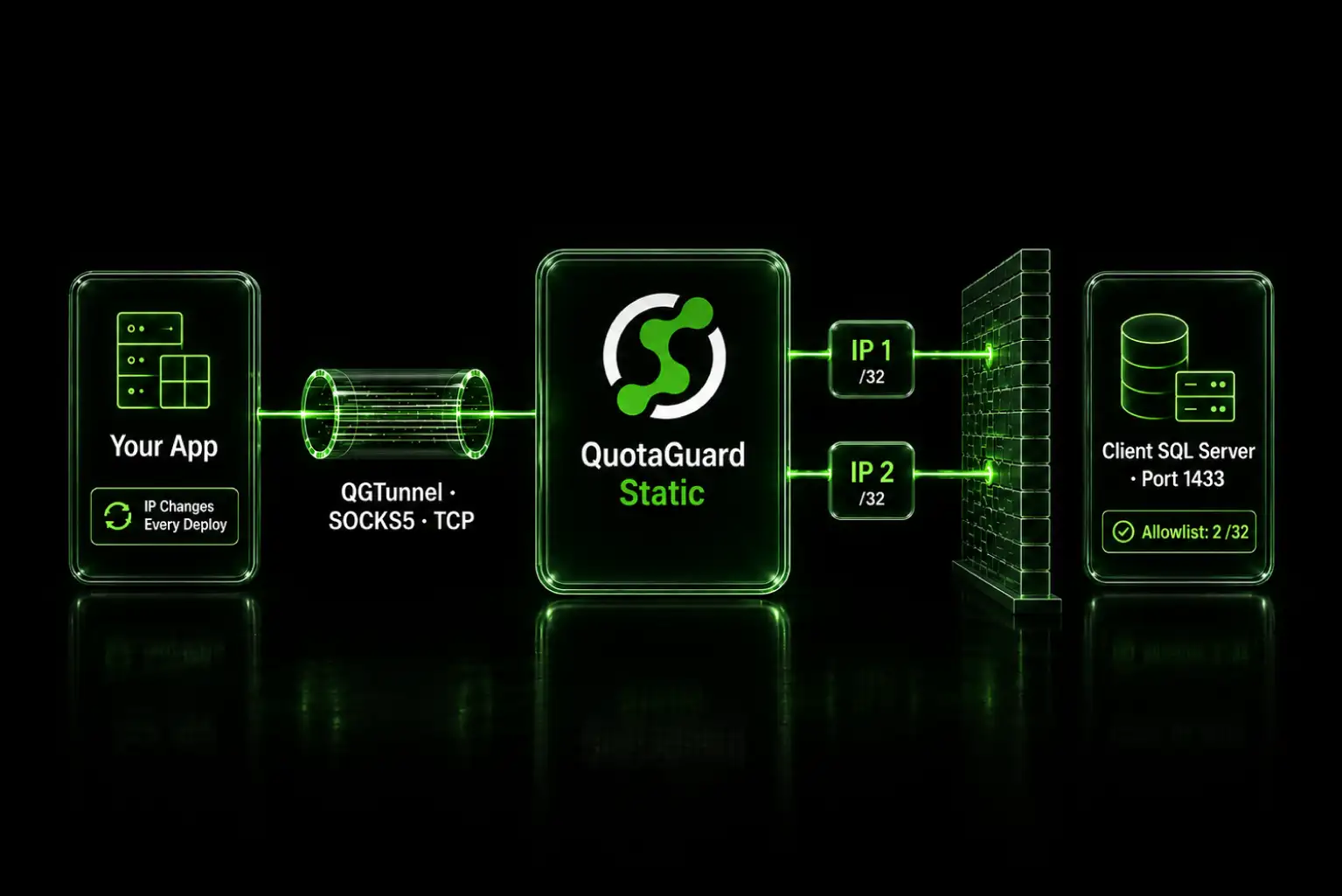
If yes, QuotaGuard works. You add your proxy URL, outbound traffic exits from your two static IPs, and you give those IPs to the API vendor to allowlist. No additional infrastructure, no intermediary servers.

If no, QuotaGuard can't help directly. The platform controls the HTTP transport layer and doesn't expose a hook to redirect it.

That's the whole framework. Everything else follows from it.

Why n8n, Make, and Zapier Work

These platforms expose proxy configuration because their HTTP request nodes give you control over how the request is sent, not just what it contains. In n8n, you set HTTP_PROXY in your environment variables and n8n's HTTP Request node respects it automatically. In Make, there's a proxy field directly in the HTTP module. In Zapier, Python steps can pass a proxy URL to the requests library explicitly.

In each case, the platform hands you enough of the transport layer to inject a proxy. That's the capability that matters.

Why Xano Doesn't

Xano's External API Request function exposes URL, method, headers, parameters, timeout, and SSL settings. There's no proxy field. There's no upstream proxy URL. There's no system-level environment variable mechanism that would let you set HTTP_PROXY at the instance level.

We confirmed this directly in Xano's documentation. The function is well-designed for what it does — making outbound API calls from a no-code backend — but routing those calls through a third-party proxy isn't something it supports.

Xano does have a native Static IP (Outgoing) feature as a paid add-on, and that's the straightforward answer for Xano users who need a fixed egress IP. The price isn't publicly listed — you'll find it in the billing screen of a paid instance. If the cost works for your situation, that's the path of least resistance. If it doesn't, the DIY alternative is running your own Nginx relay server that forwards requests from Xano to your target API, but that's infrastructure you're operating yourself.

How to Evaluate Your Own Platform

If you're on a platform not listed here and you're trying to figure out whether QuotaGuard will work, here's what to look for:

Search your platform's docs for any of these terms: "proxy," "HTTP proxy," "upstream proxy," "outbound proxy," or "proxy URL." If you find a field or environment variable that accepts a URL in the format http://username:password@host:port, QuotaGuard will work.

If you find nothing, check whether the platform lets you run arbitrary code in a scripting step. Python's requests library accepts a proxy URL directly. Node.js works with https-proxy-agent. If you can write a few lines of code in a custom step, you can usually route that request through QuotaGuard even if the platform's native HTTP module doesn't support it natively. That's how Zapier Python steps work.

If neither of those options exists, the platform controls its own HTTP transport and there's no hook available. You'd need a native static IP feature from the platform itself, or an intermediary service you control.

Platforms We've Confirmed Work

These all support QuotaGuard's proxy URL natively or through a scripting step: n8n, Make, Zapier (Python steps), Retool, Bubble.io, and all the standard cloud deployment platforms — Heroku, Render, Fly.io, Railway, AWS Lambda, Azure Functions, Google Cloud Run, and Kubernetes. Full setup guides for each are at quotaguard.com/company/integrations.

If you're on a platform that isn't listed and you're not sure, the diagnostic above will tell you quickly. And if you want to check before you sign up, reach out — Randall will give you a straight answer the same way he did here.

Plans start at $19/month. Pricing is here.

QuotaGuard Static IP Blog

Practical notes on routing cloud and AI traffic through Static IPs.

Reliability Engineered for the Modern Cloud

For over a decade, QuotaGuard has provided reliable, high-performance static IP and proxy solutions for cloud environments like Heroku, Kubernetes, and AWS.

Get the fixed identity and security your application needs today.