
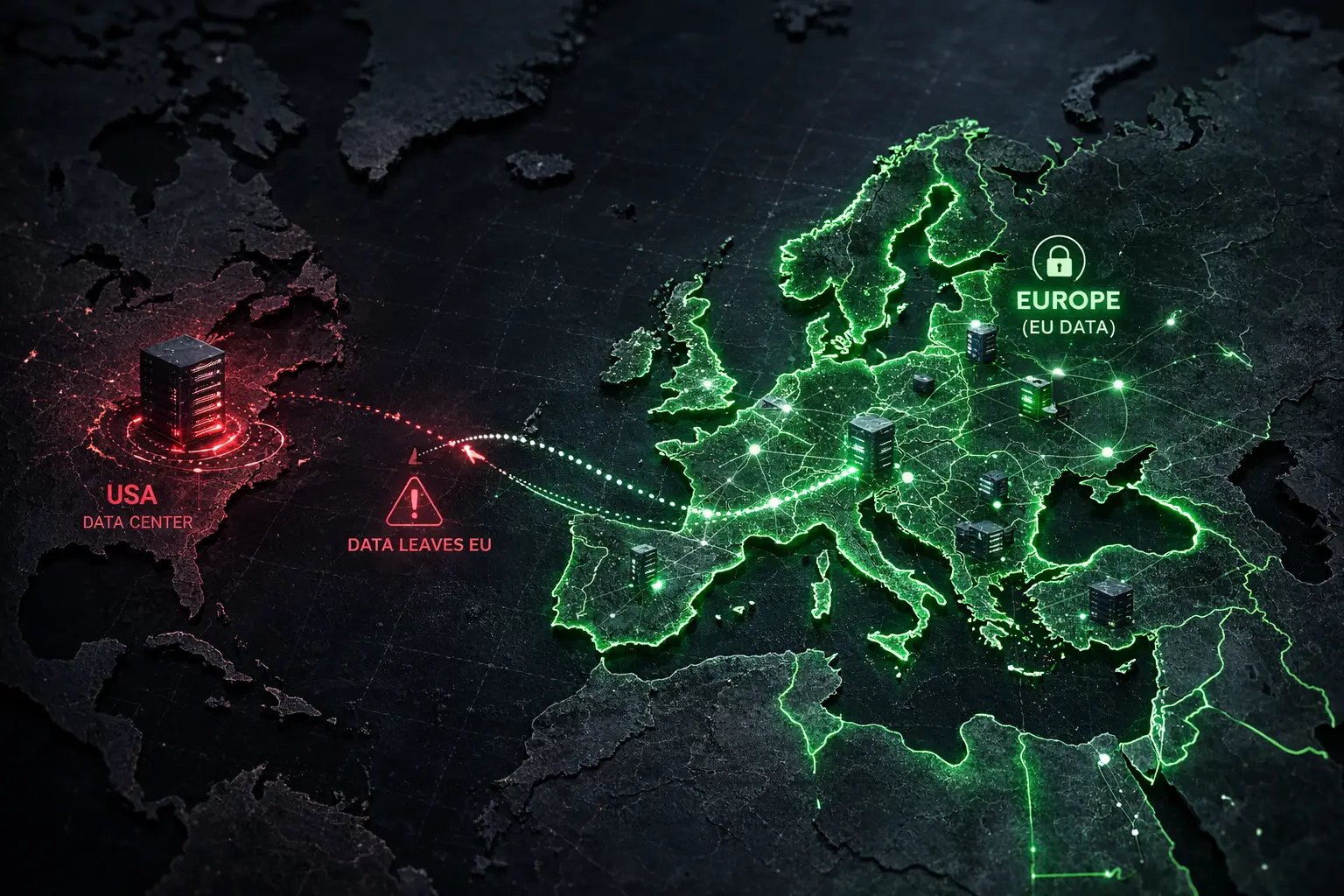
If your SaaS company serves European customers and handles their personal data, your proxy infrastructure is part of your data architecture. Most proxy services route traffic through US data centers by default. Under GDPR Chapter V, that can constitute a transfer of EU personal data to the United States.
This is the kind of thing that's easy to overlook until a compliance review catches it.
The Post-Schrems II Landscape
Since the Schrems II ruling in 2020, the rules around EU-to-US data transfers have tightened. The European Court of Justice invalidated the Privacy Shield framework. Standard Contractual Clauses (SCCs) still work, but data protection authorities now scrutinize them more closely.
The practical impact: if your proxy sits in Virginia or Oregon, and an EU customer's API request carries personal data through it, you've transferred EU personal data to the US. Even if it's just passing through. Even if it's encrypted. The transfer happened.
Where Proxies Fit In
Say you're a European SaaS company. Your infrastructure is in the EU. Your customers are in the EU. You use a proxy for static IP whitelisting to connect to a third-party API.
If that proxy routes through US infrastructure, any personal data in the request body (names, emails, phone numbers, payment details) has technically been exposed to US jurisdiction. Most "global" proxy networks aren't region-locked. The control plane is centralized. Logs might touch US servers. Metadata might route through US infrastructure even if the payload doesn't.
This matters to GDPR compliance officers, especially in fintech, healthcare, and B2B SaaS where data processing agreements (DPAs) often explicitly require EU-only data transit.
QuotaGuard's EU Regionality Add-On
We built a US/EU Data Regionality add-on specifically for this. It region-locks your entire proxy infrastructure. All traffic enters and exits QuotaGuard exclusively within EU data centers. Ireland (EU-West-1). Frankfurt (EU-Central-1). No US touchpoints. Not your traffic. Not your metadata.
Your EU application connects to a QuotaGuard load-balanced static IP in Ireland or Frankfurt. Traffic routes through EU infrastructure. It exits to the destination API. The whole pipe stays within the European Union.
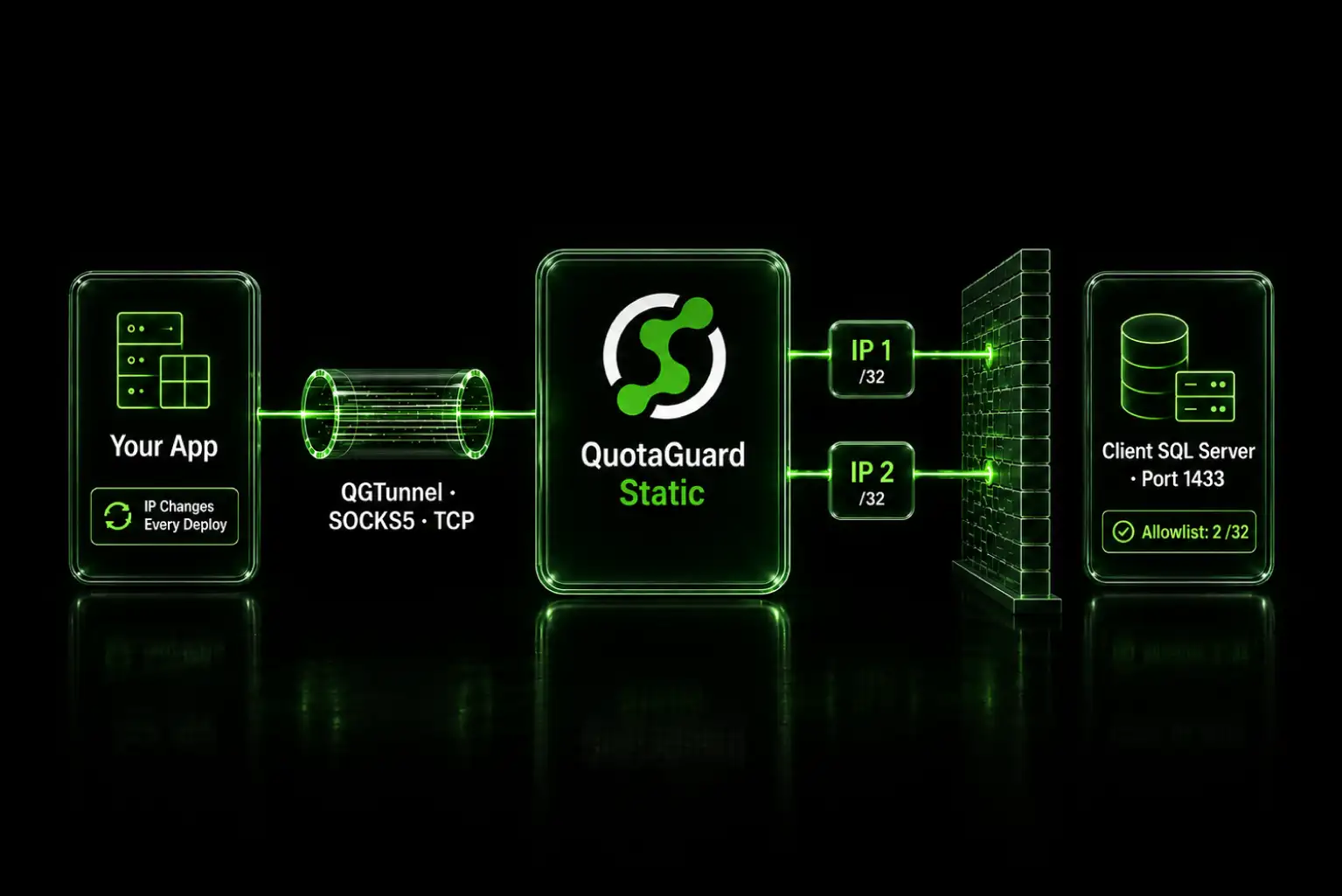
You get two static IPs per subscription with automated failover between Ireland and Frankfurt. It works with HTTP proxy, SOCKS5, and QGTunnel. If you're also using Shield, you get SSL passthrough on top of the geographic boundary.
Cost and Context
The data regionality add-on is $899 per month on top of your base QuotaGuard Shield plan ($29/month starter). That's $10,788 per year.
For context, GDPR fines can reach 4% of annual global turnover. For a company processing $10 million a year, that's a potential $400,000 fine. The add-on is effectively compliance insurance, and it's useful documentation for DPA conversations with customers who require EU-only data transit.
Who Needs This
Not every company does. If you're US-only, not collecting personal data from EU residents, or not handling sensitive data types, a standard proxy setup is fine.
It becomes relevant if: you have EU customers whose personal data flows through your proxy, you're a European company required by local law to keep data in-region, you work in a regulated vertical like healthcare or fintech, or you have DPAs with customers that explicitly require EU-only data transit.
Setting It Up
The engineering lift is minimal. We handle the infrastructure complexity. You configure your application to use the regional static IPs through your SOCKS5 or HTTP proxy settings. Everything else is transparent.
Layered with Shield, you get SSL passthrough, end-to-end encryption, and regional isolation. Your traffic is encrypted. It never leaves the EU. Your destination sees your static IP as the source.
The Bigger Picture
GDPR compliance isn't just about your proxy. DNS, logging, CDN, app servers, backups. It all matters. EU data residency on your proxy doesn't make you fully compliant if everything else is in the US.
But it does eliminate one real vector of exposure. And for companies going through GDPR compliance reviews, having documented region-locked proxy infrastructure is one less thing to worry about.
Next Steps
If you need region-locked proxy infrastructure, sign up to explore QuotaGuard with EU data residency. Talk to your legal team about whether your current proxy setup qualifies as a data transfer under Chapter V. It's worth checking.
QuotaGuard Static IP Blog
Practical notes on routing cloud and AI traffic through Static IPs.