Static Outbound IPs for RazorpayX API Workloads
Give proxy-compatible application requests a predictable outbound identity with QuotaGuard. Keep your existing cloud hosting, route the selected HTTPS calls through an explicit proxy client, and manage a small, stable egress allowlist.
RazorpayX documents live-mode IP restrictions for payout-related APIs. Plan the network path alongside your production launch, rather than discovering that a working development integration uses a different source address in production. Review Razorpay’s requirements.
Primary action: Discuss your outbound setup
Secondary action: Explore QuotaGuard Static
Keep your application where it runs today
An outbound proxy can be a focused alternative to moving an application or redesigning its entire network. Configure the HTTP requests that need a fixed source address, while leaving unrelated application traffic on its existing path.
Use this approach when you control the request-making client and can configure its proxy transport. If your hosting environment already provides an approved stable egress route, that existing route may be sufficient.
Include workers and scheduled jobs
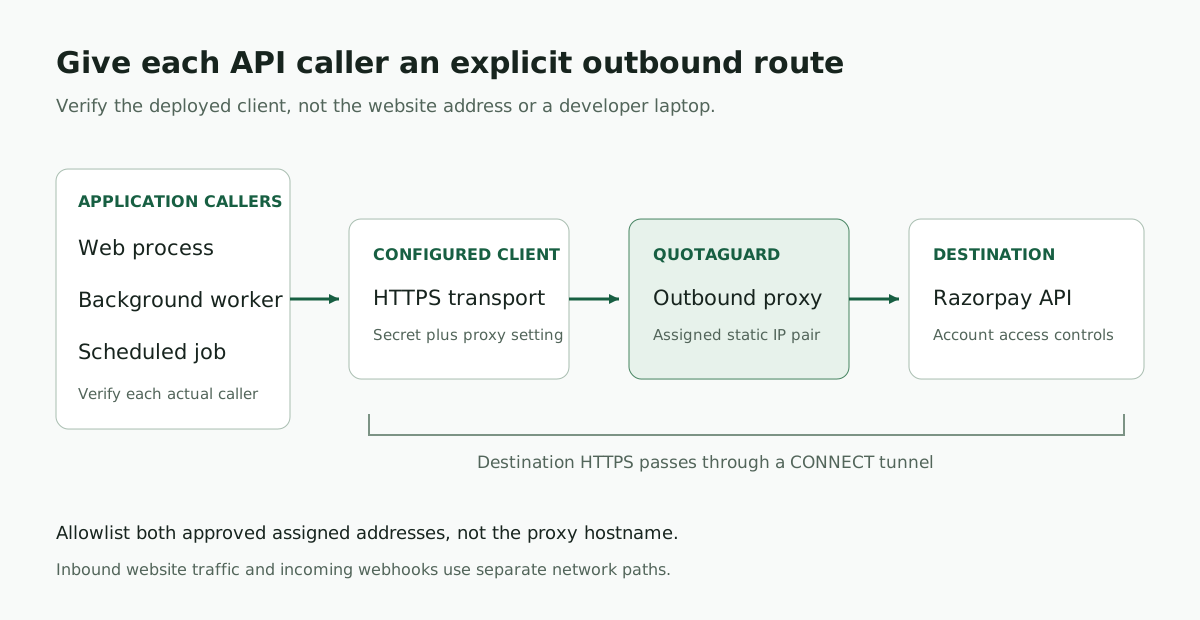
A payout workflow often spans more than the web process. The background worker may open the API connection, while a scheduled process handles later reconciliation. Each caller needs the right configuration and a source-IP check from its own deployed environment.
A diagnostic run on a developer laptop or a web container does not cover a separate worker. Build the route into the integration’s client factory and reuse it wherever that integration runs.
Use the dashboard pair for the destination allowlist
Configure the connection URL supplied by your QuotaGuard subscription, then use both assigned static IPs for the approved destination allowlist. Keep the connection URL private. It is not the value to paste into an IP allowlist, and resolving its hostname is not a substitute for reading your assigned addresses.
The connection-details guide and two-address explanation cover these separate configuration values.
Verify routing before financial operations
Use a non-mutating HTTPS source-IP check to establish which address a deployed client uses. Compare it with the assigned pair and repeat from each relevant process after deployment.
Keep network verification separate from payout acceptance testing. An observed egress address is evidence about the route, not confirmation of API authorization or transaction processing. Do not create live financial operations as a connectivity probe.
Choose a route that matches your requirements
Confirm that the destination accepts the proposed addresses, shared or dedicated arrangement, and geographic route for your account. Review the HTTP library or SDK’s proxy support before implementation. QuotaGuard supplies the egress layer; the destination controls access to its API.
Shared and dedicated infrastructure serve different requirements. Review the current plans when choosing the arrangement, and confirm any regional requirement before provisioning.
Preserve destination HTTPS
QuotaGuard Static’s HTTPS CONNECT tunnel preserves TLS between your application and the HTTPS destination without decrypting the API payload. The proxy connection itself has its own transport properties, so review those alongside your credential-handling and security requirements. Learn how outbound HTTPS works.
Common questions
Does this change my website or webhook address?
No. Explicit outbound client configuration changes the route for those outgoing requests. Your website’s inbound address and a provider’s incoming webhook connection are separate paths.
Will an environment variable configure every SDK?
Only a client that consumes the setting will use it. Configure the actual request-making transport and verify its behavior. Another SDK or background process may need a separate setting or supported transport adapter.
Should a failed proxied request retry directly?
No. A direct fallback changes the intended network route. Keep the failure visible and use a controlled recovery plan. Financial requests also need their own retry and reconciliation rules.
Does a static IP replace API authentication?
No. Keep the destination’s credentials and permissions in place. IP restrictions and authentication are different controls.
Plan your outbound path with QuotaGuard
Bring your hosting platform, language, HTTP client or SDK, caller inventory, and destination requirements. We can help you identify where proxy configuration belongs and which QuotaGuard arrangement to evaluate.
Guides and examples
Table of contents
- Configure and Verify Fixed Egress for RazorpayX API Clients
- RazorpayX example code and offline checks
- Troubleshoot Outbound IP Problems in a RazorpayX Integration