Give Your Bank API Integration a Static IP for Firewall Allowlisting

QuotaGuard Engineering
May 13, 2026
5 min read
Pattern

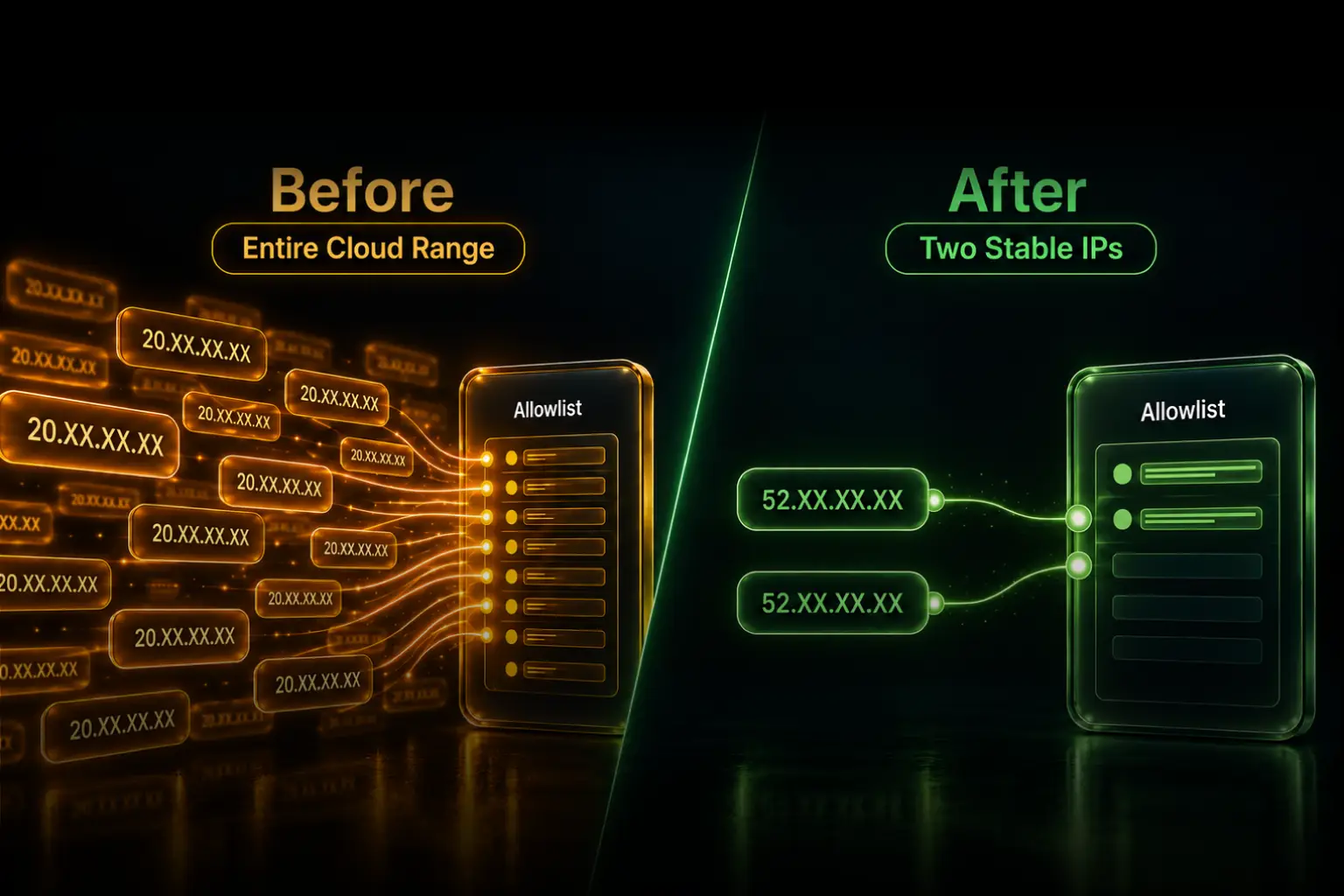
Banks don't trust dynamic IPs. When your cloud app connects to a financial institution's API, the bank's firewall checks the source IP against a pre-approved list. If your IP isn't on that list, the request is rejected. Cloud platforms assign ephemeral IPs that change constantly. That's the problem. A static IP proxy solves it in 2 minutes.

Bank API Firewalls Require a Static Source IP

Financial institutions enforce IP allowlisting at the network layer for every inbound API connection. It doesn't matter how strong your OAuth token or API key is. If the request arrives from an IP the bank hasn't approved, it's rejected before authentication even runs.

This is a feature, not a bug. It means an attacker who steals your credentials still can't initiate transactions from their own infrastructure. The allowlist is a second factor at the network layer.

The challenge is that cloud apps on platforms like AWS Lambda, Render, Railway, Heroku, or Fly.io don't have fixed outbound IPs. They share address pools with thousands of other tenants. Your outbound IP changes on every deploy, every restart, and sometimes mid-session.

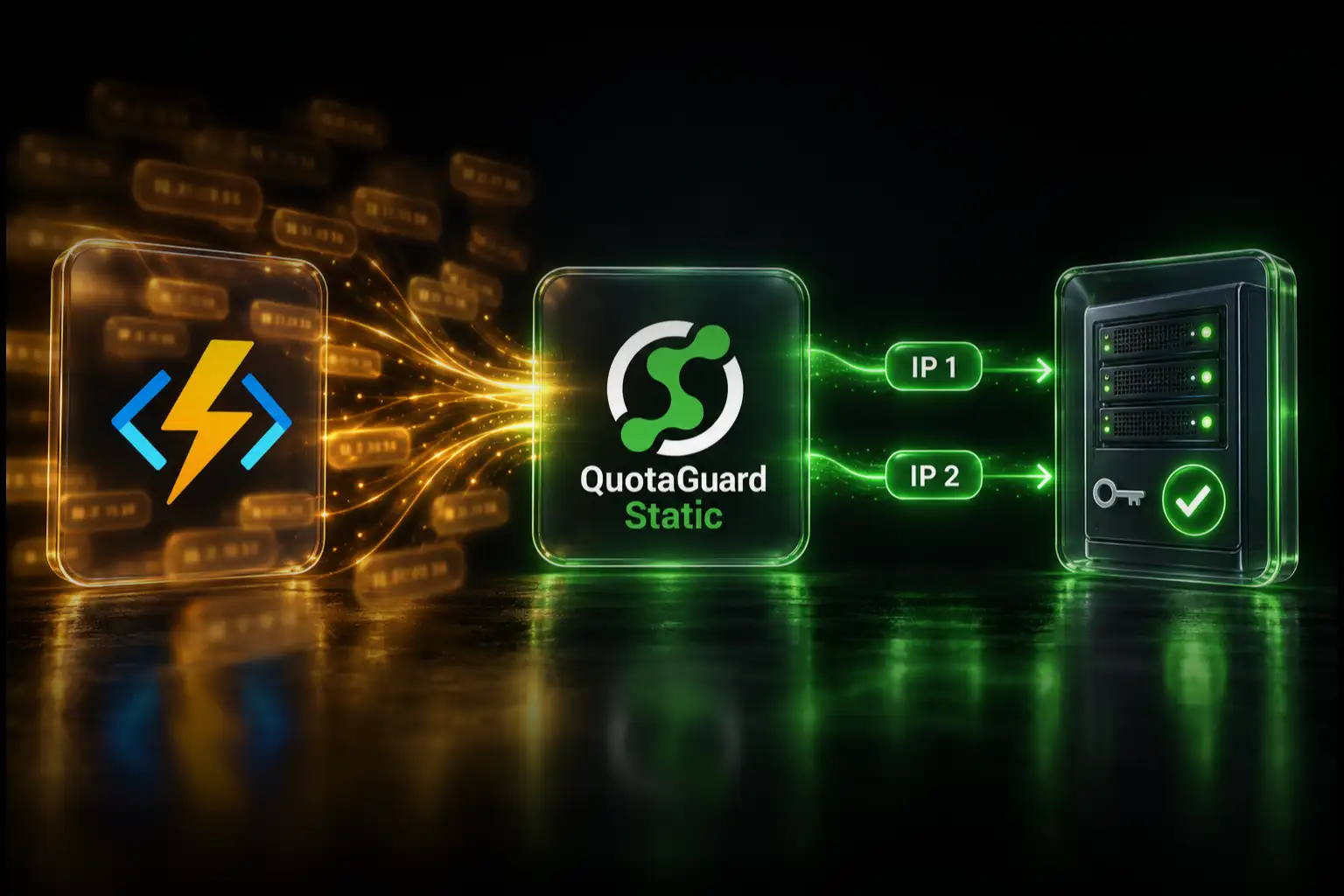
You need a static IP your bank can approve once and trust permanently. QuotaGuard Shield gives you that IP, and because it uses SSL passthrough, your financial data is never decrypted in transit.

QuotaGuard Shield Is the Right Product for Financial Data

QuotaGuard offers two proxy products. For bank API integrations, use QuotaGuard Shield, not QuotaGuard Static.

The difference matters here. QuotaGuard Static is a standard HTTP/HTTPS proxy. It terminates and re-establishes the SSL connection, which means the proxy infrastructure sees your traffic. That's fine for most use cases.

QuotaGuard Shield uses SSL passthrough. The TLS connection runs end-to-end between your application and the bank's API endpoint. QuotaGuard routes the packets but never decrypts them. Your transaction data, account numbers, and payment payloads are never exposed to a third party in transit.

For PCI-DSS compliance, this matters. For HIPAA-adjacent fintech use cases, this matters. For any security officer trying to answer "does a third party have access to our payment data in transit," Shield gives you a clean answer: no.

Both products run on QuotaGuard's AWS infrastructure across 10 regions. You pick the region closest to your bank's API endpoint to minimize latency.

Static IP Setup for Bank APIs Takes 2 Minutes

The setup is one environment variable and a small change to how you initialize your HTTP client.

Step 1: Sign up and get your Shield URL

Create an account at quotaguard.com/products/quotaguard-shield. Your dashboard shows your static IP addresses and your QUOTAGUARDSHIELD_URL connection string. That URL is in the format:

https://username:password@us-east-shield-01.quotaguard.com:9294

Pick the region closest to your bank's API servers. QuotaGuard runs in US-East, US-West, EU-West, EU-Central, AP-Northeast (Tokyo), AP-Southeast (Singapore), and five more AWS regions.

Step 2: Set the environment variable

QUOTAGUARDSHIELD_URL=https://username:password@us-east-shield-01.quotaguard.com:9294

Set this in your platform's environment config. Heroku config vars, AWS Lambda environment variables, Render environment settings, Railway variables. All of them work the same way.

Step 3: Route your bank API calls through the proxy

Point your HTTP client at QUOTAGUARDSHIELD_URL for the calls that need to reach the bank. Route only those calls through the proxy, not all outbound traffic. It's faster and easier to debug.

import os
import requests

proxy_url = os.environ.get("QUOTAGUARDSHIELD_URL")

proxies = {
    "http": proxy_url,
    "https": proxy_url,
}

# Only bank API calls route through the proxy
response = requests.post(
    "https://api.yourbank.com/v1/payments",
    json=payload,
    proxies=proxies,
    headers={"Authorization": f"Bearer {api_token}"}
)
import axios from "axios";
import { HttpsProxyAgent } from "https-proxy-agent";

const proxyUrl = process.env.QUOTAGUARDSHIELD_URL;
const agent = new HttpsProxyAgent(proxyUrl);

// Only bank API calls use the proxy agent
const response = await axios.post(
  "https://api.yourbank.com/v1/payments",
  payload,
  {
    httpsAgent: agent,
    headers: { Authorization: `Bearer ${apiToken}` },
  }
);

Step 4: Give your static IPs to the bank

Your QuotaGuard dashboard shows the two static IPs assigned to your account. Send those to your bank's technical team or enter them into the bank's developer portal allowlist. Once approved, every API call routes through those IPs. The bank's firewall sees the same source addresses every time.

Static IPs Work With Payload Signing, Not Instead of It

IP allowlisting is a network-layer control. It stops requests from unauthorized sources. It doesn't protect against a compromised server sending a malicious payload.

That's why well-designed bank API integrations combine IP allowlisting with payload signing. Your system generates a digital signature for each outbound request using a private key. The bank verifies the signature with your public key. If a request is intercepted and the payload is modified (transaction amount, beneficiary account, routing number), signature validation fails and the bank rejects it.

QuotaGuard Shield's SSL passthrough strengthens this. Because the TLS connection is end-to-end, there's no point in transit where payload inspection or modification is possible. Your signed payload arrives at the bank's endpoint exactly as your application sent it.

The security stack in practice:

  • IP allowlisting: the bank's firewall accepts requests only from your static IPs
  • TLS end-to-end: Shield routes without decrypting, no third-party exposure in transit
  • Payload signing: the bank verifies every request payload hasn't been altered
  • API key rotation: time-limited credentials reduce the window of exposure if keys leak

Each layer covers a different attack vector. None of them replace the others.

QuotaGuard Shield Pricing Starts at $29/Month

QuotaGuard Shield direct plans:

PlanPrice/moBandwidth included
Starter$2910 GB
Production$5950 GB
Business$109200 GB
Enterprise$2691 TB

Bandwidth is bundled. No per-GB overage fees. Most bank API integrations move structured JSON payloads and operate well inside the Starter or Production bandwidth limits.

Enterprise plans ($269/month) include dedicated static IPs. Starter through Business plans use IPs shared across a small pool of QuotaGuard customers. For banks that require a dedicated, single-tenant IP assignment, Enterprise is the right tier.

All plans include a 3-day trial. Enterprise includes a 7-day trial. Credit card required.

QuotaGuard tip: based on support patterns, use selective proxying from day one. Route only your bank API calls through Shield. Keep everything else on direct connections. It reduces latency, simplifies debugging, and makes your compliance scope smaller.

See full pricing for QuotaGuard Shield and QuotaGuard Static →

QuotaGuard Static IP Blog

Practical notes on routing cloud and AI traffic through Static IPs.

Reliability Engineered for the Modern Cloud

For over a decade, QuotaGuard has provided reliable, high-performance static IP and proxy solutions for cloud environments like Heroku, Kubernetes, and AWS.

Get the fixed identity and security your application needs today.